In this article
Research on decentralized federated learning benefits from a sequence that moves from map to mechanism to evidence. The doctoral thesis follows that logic: first it characterizes the field, then it tests reliability in a concrete operational scenario and finally it designs a protocol for heterogeneous multimodal clients.
This is more than a convenient chapter order. Each stage narrows a different uncertainty. A survey reveals which assumptions are repeated across the literature. A controlled system study shows how those assumptions behave under a threat model. A new learning mechanism tests whether the protocol can address a limitation that remains visible after the first two stages.
Stage 1: build the map
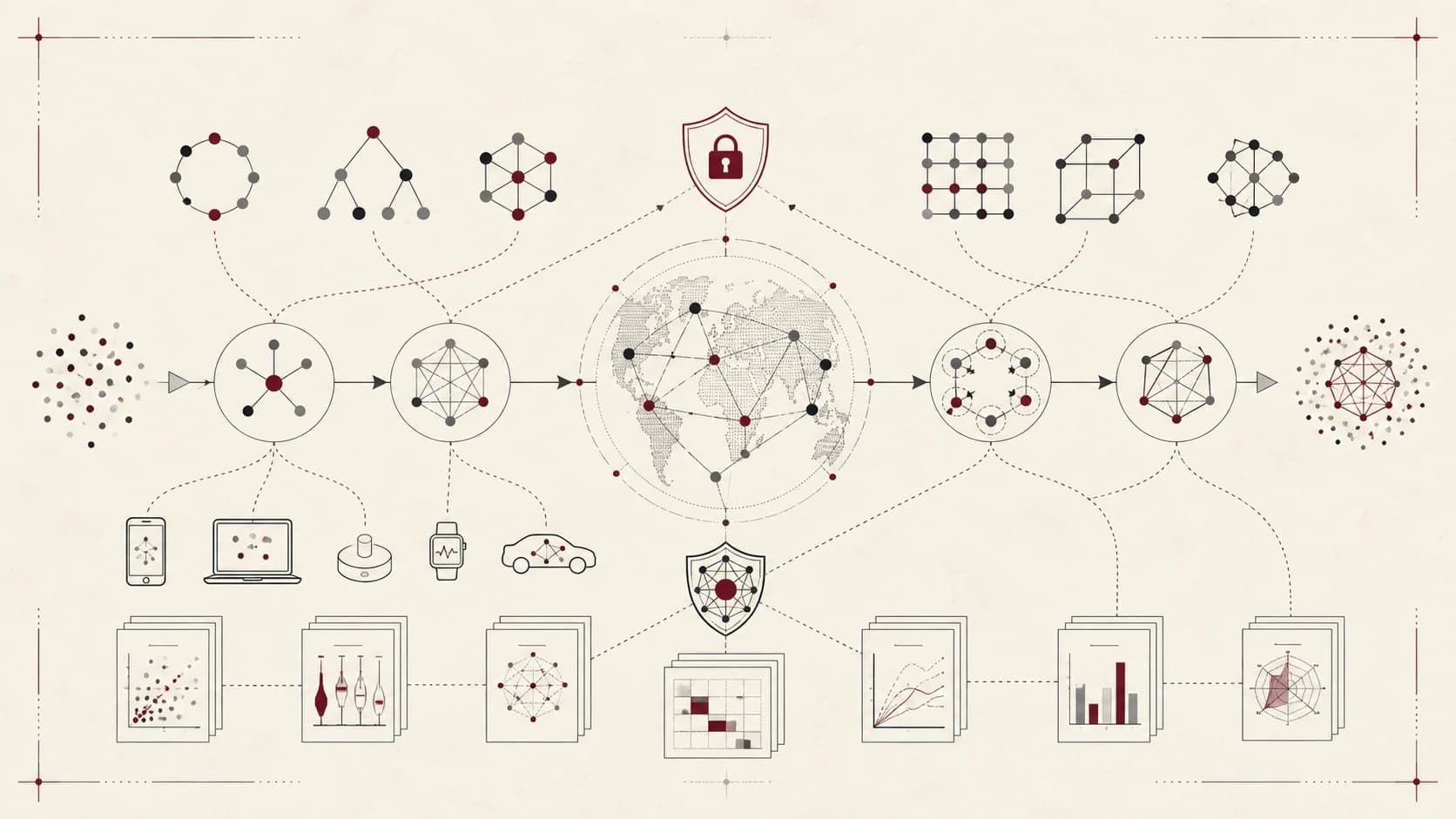
The survey publication organizes DFL around architectures, components, topologies, communication, security, privacy, optimization, frameworks and applications. It also asks how systems are evaluated. That map is valuable because terminology alone can hide different responsibilities: two papers may both say “decentralized” while using different neighbor rules, aggregation semantics or trust assumptions.
A useful output of this stage is a design matrix:
| Question | Examples of answers |
|---|---|
| Who communicates? | peers, clusters or changing neighborhoods |
| What is shared? | parameters, gradients, prototypes or statistics |
| How is influence decided? | fixed weights, consensus or trust-aware rules |
| What can fail? | links, clients, resources, labels or modalities |
| How is success measured? | quality, cost, convergence and resilience |
Stage 2: choose a demanding scenario
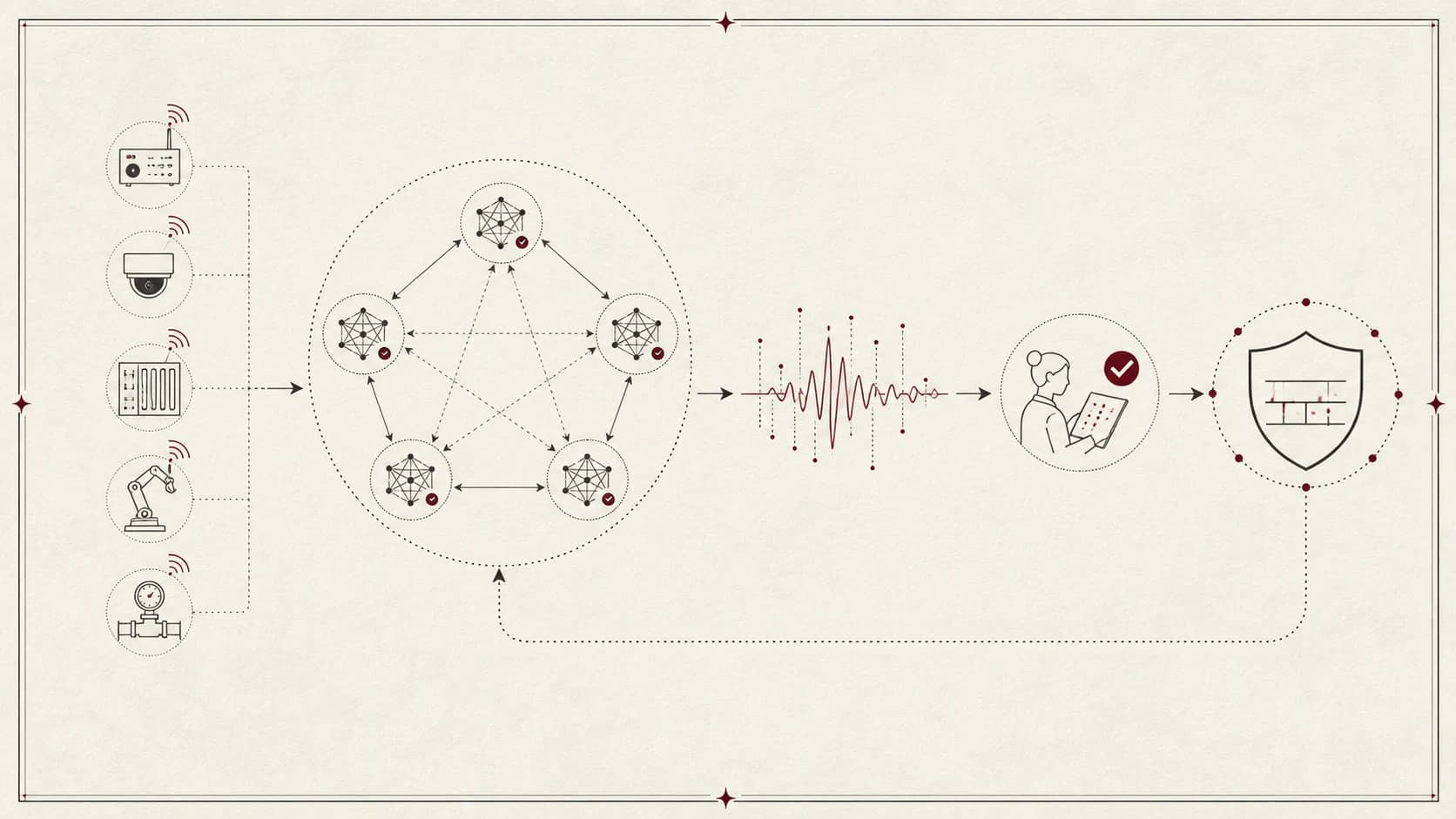
Flighter instantiates the reliability problem in a simulated military aerial-reconnaissance setting. Four SAR-equipped aircraft collaborate while their formation, position, interconnection behavior and resources become part of the context. The experiment uses VGG16 and MSTAR, SAMPLE and OpenSARShip to make the threat discussion measurable.
This stage is important because it prevents a robustness claim from remaining abstract. It forces the research to define indicators, normalize them, compare them with a dynamic threshold and decide what happens to a contribution whose evidence becomes weak. It also keeps a baseline without the extra situational-awareness mechanism.
Stage 3: address a different source of difficulty
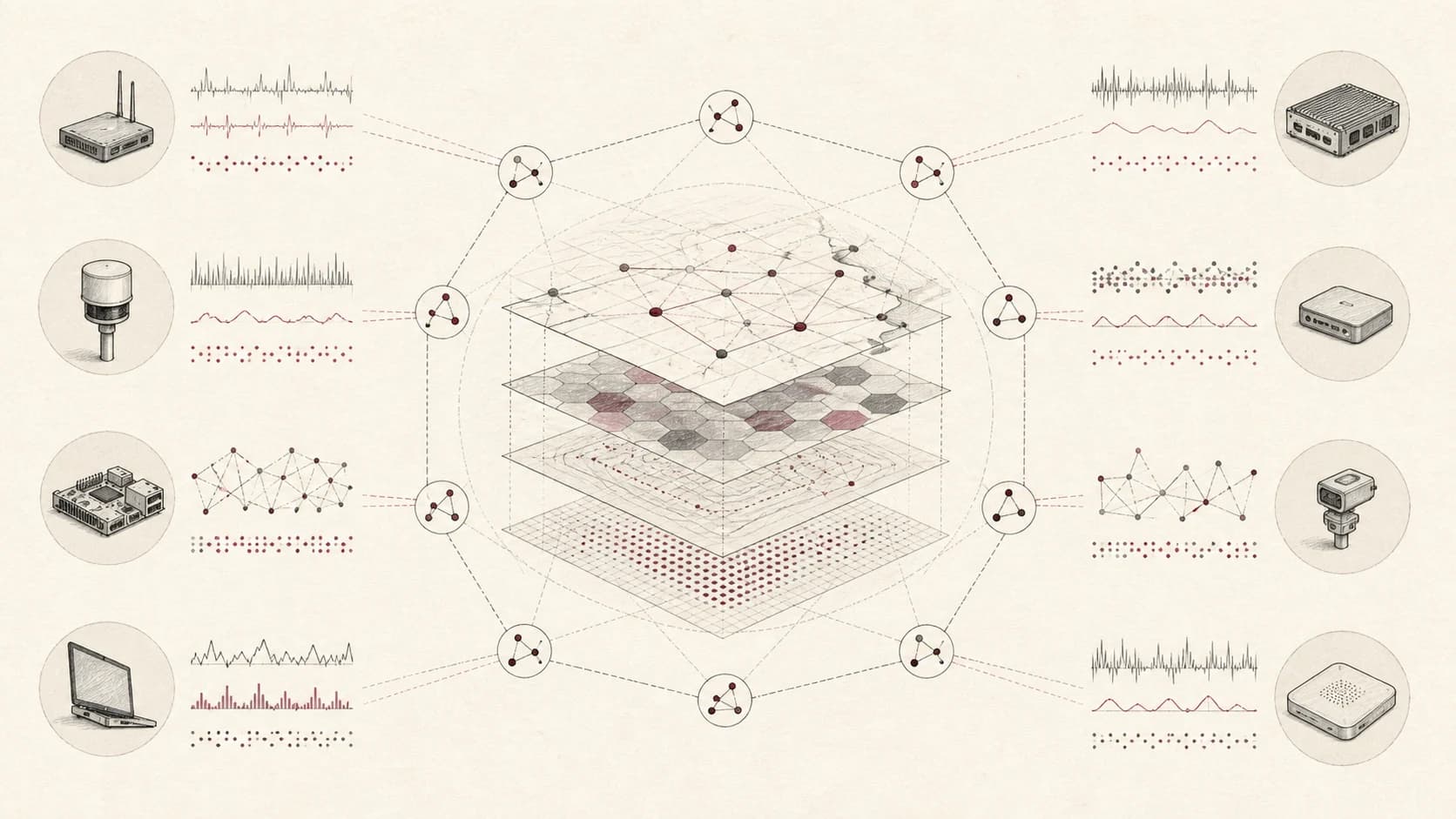
The Modalis contribution moves from adversarial context to heterogeneous observations. Clients can have different class distributions and different or missing modalities. The protocol exchanges compact prototypes and adds contextual placeholders, adaptive gating, multimodal fusion and alignment objectives.
The datasets are deliberately varied: AVMNIST, CREMA-D, UCI-HAR and CRISIS-MMD. The main experiments use 20 clients on a specified Erdős-Rényi graph, with controlled class skew and missing-modality probabilities. This makes the comparison interpretable while leaving room for future work on dynamic topology and real deployments.
Why the sequence is useful
The stages share a vocabulary without forcing one solution onto every problem. The survey identifies design dimensions. Flighter shows that operational reliability can influence decentralized aggregation. Modalis shows that the exchanged object itself can be redesigned when full-model sharing is a poor fit for partial views.
The result is a research workflow that can be reused:
- map the design space and expose hidden assumptions;
- select one failure or heterogeneity mechanism;
- define an operationally meaningful scenario;
- implement the smallest mechanism that addresses the limitation;
- evaluate quality, cost, resources and failure behavior together;
- state the conditions under which the result should not be generalized.
Connecting the publications
The three constituent articles are available as a survey in IEEE Communications Surveys and Tutorials, the Flighter study in IEEE Communications Magazine and the Modalis study in Information Fusion. Reading them as a sequence makes the progression visible without treating the final mechanism as a universal answer.
The broader lesson is methodological. DFL research becomes more credible when architectural claims, threat assumptions, data heterogeneity and measurement choices are connected. A map without an experiment is too abstract. An experiment without a map can optimize the wrong problem. A mechanism without a clear boundary can be oversold.
Turn a reading into a falsifiable hypothesis
A literature matrix is more useful when it preserves limitations alongside results. For each publication, record the graph, exchanged object, privacy unit, adversarial behavior, datasets and stopping criteria. Mark unspecified details as unknown; do not fill gaps from a method's name.
As a methodological example, turn “prototypes communicate less” into a concrete hypothesis: under a fixed partition and quality target, do they reduce cumulative bytes including control and retries? The second formulation can fail and is therefore more informative.
A record before execution
I propose storing the primary objective, comparators, budget, seeds and exclusions before running tests. When a decision changes, retain the revision and reason. This does not prevent exploration; it distinguishes confirmatory tests from exploratory findings.
Associate every final number with a run, configuration and metrics file. Publish dispersion and failures in figures too. Partial reproduction can be valuable when it explains what was verified and which dependencies were missing.
Follow the series by question
For network coordination, start with the DFL design guide. For operational reliability, use the Flighter note. For partial views, continue with Modalis.
These routes correspond to the three publications linked above, but their configurations are not interchangeable. The methodological contribution is traceability between question, mechanism and evidence, including when the next result contradicts the initial intuition.