In this article
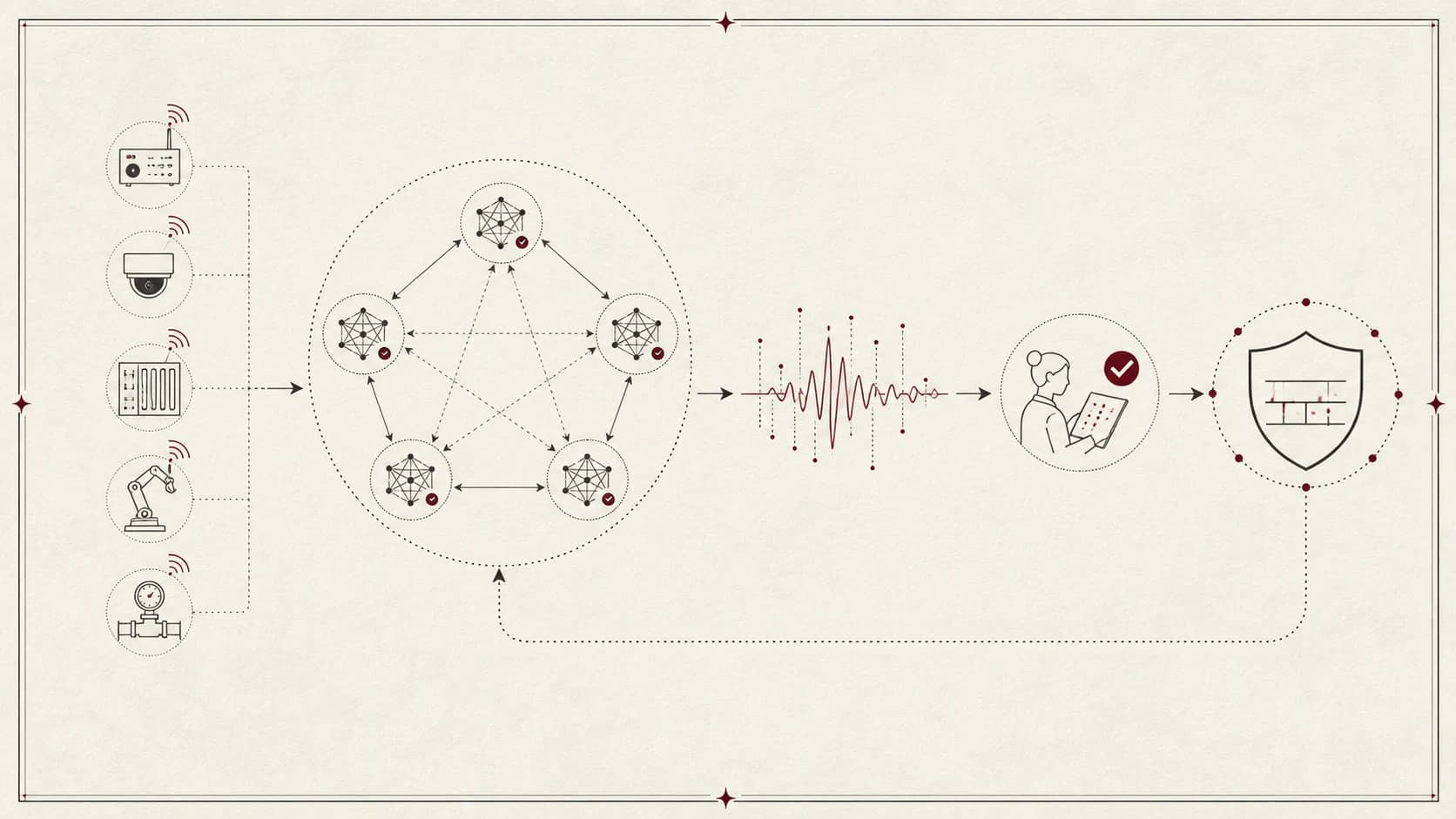
Cyberdefense does not end when a model predicts an anomaly. A useful system needs a loop: monitor the environment, train or update models, run inference, detect alerts, explain the situation, recommend mitigations, and feed the outcome back into the next training cycle.
This is where decentralized federated learning becomes useful beyond the training stage.
1. Monitoring
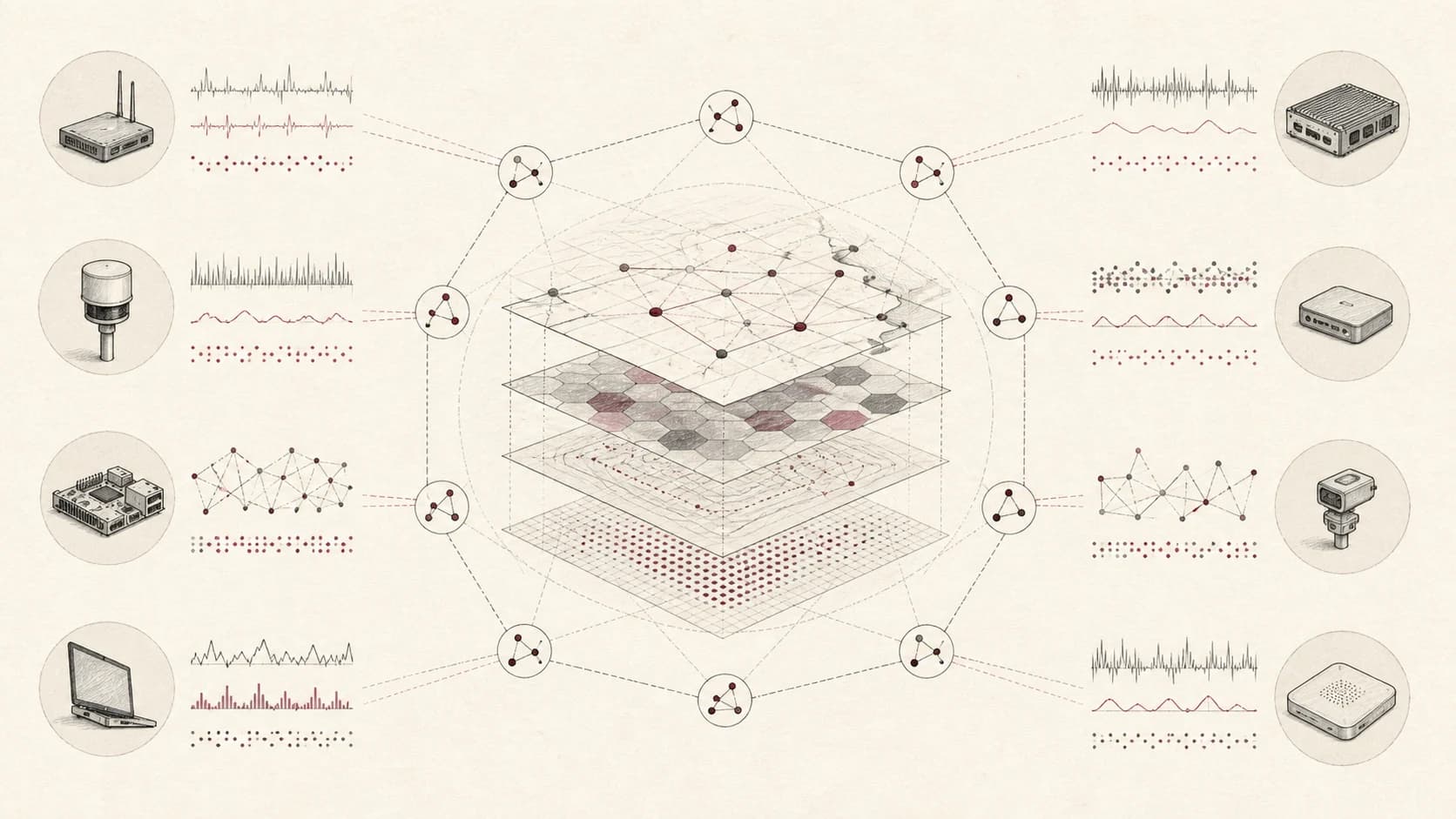
The first layer is distributed monitoring. Edge nodes, sensors, network functions, drones, IoT gateways or industrial controllers observe local behavior and generate telemetry. The important design constraint is that not every participant can or should centralize raw data.
Monitoring should collect enough structure to support security decisions:
- anomaly indicators,
- event timestamps,
- local context,
- model confidence,
- peer trust signals,
- mitigation outcomes.
2. Federated training
Instead of sending all telemetry to a central training pool, each participant trains locally and shares bounded model updates. In a DFL setting, aggregation can happen directly between neighboring nodes or through semi-decentralized topologies, which removes a single central dependency.
The security question is not only accuracy. The system must handle poisoning, delayed updates, unreliable peers and non-IID local data.
3. Inference and alert detection
Inference should run close to the monitored environment whenever latency matters. Alerts should include the model score, the local context and the evidence that caused escalation.
An alert is weak if it only says "attack". It is stronger when it says:
- what changed,
- where it changed,
- how confident the model is,
- whether other peers see similar patterns,
- which mitigation options are available.
4. Using LLMs to support mitigation
LLMs should not replace the detector or execute defensive actions on their own. A more realistic role is to sit after detection and help turn technical evidence into an explanation of the attack, a few plausible hypotheses and mitigation options for an operator.
A useful LLM layer should receive structured security context, not vague prompts. It can produce:
- a plain-language summary,
- likely attack hypotheses,
- confidence caveats,
- recommended mitigation actions,
- links to playbooks,
- questions for the human analyst.
A minimal evidence package could look like this:
Telemetry window -> local DFL inference -> anomaly score
  -> peer agreement and drift checks
  -> evidence package: asset, time window, symptoms, confidence, constraints
  -> explanation and mitigation options supported by an LLM
  -> analyst approval or rejection
  -> mitigation outcome recorded for the next learning cycle
For example, if several edge nodes report unusual authentication bursts and lateral connection attempts, the LLM should not "decide" the response. It should summarize the evidence, relate it to plausible attack stages, suggest bounded options such as isolating a segment or increasing monitoring, and leave the decision to the analyst.
5. Mitigation and feedback
The mitigation stage should be explicit: block, isolate, rate-limit, rotate keys, change policies, trigger extra monitoring or keep observing. An LLM can help explain why a mitigation is plausible, what evidence supports it and what risk remains, but the action should still be bounded by approved playbooks and human oversight. The result of that mitigation becomes feedback for the next training and evaluation cycle.
The goal is not a black-box autonomous system. The goal is a traceable loop where DFL provides collaborative learning, detection models provide evidence, and LLMs help humans understand the attack and compare mitigations faster.
Key takeaway
The useful role for LLMs is narrow and operational: translate structured security evidence into understandable attack context and bounded mitigation choices, while DFL and detection models remain responsible for the underlying learning and alert evidence.
Open research question
How can these LLM-supported mitigation steps be evaluated so that explanations remain faithful to the evidence and recommendations stay inside approved operational playbooks?
Design rule
Treat the LLM as support for explanation and mitigation, not as the detection authority. A practical loop is: telemetry -> DFL model -> alert evidence -> LLM explanation -> mitigation options -> human approval -> feedback.
An evidence contract between detector and assistant
I propose attaching an incident identifier, model version, time window, event identifiers, observed coverage and validation state to each alert. The assistant receives an authorized view of these fields rather than unrestricted log access. Its explanation should be reconstructible from the same evidence even after the language model changes.
A common error confuses scores with probabilities. An anomaly score of 0.9 does not necessarily mean a 90% probability of attack. Translating it into operational language requires knowing its calibration and threshold. Without calibration, present it as a detector score.
Feedback needs quarantine too
A mitigation that removes an alert does not establish that the diagnosis was correct: it may have disconnected the sensor. Separate action outcome, incident verification and the training label. Only the third object should enter the next data review after validation.
As a laboratory test, replay an incident with delayed evidence, a duplicate alert and an analyst correction. Verify that the system retains one incident identity and does not count duplicates as independent corroboration. Measure complete traceability and review delay alongside F1.
NIST SP 800-61 Rev. 3 provides the response and recovery framework. The systematic review of LLMs for security places assistant capabilities in their research context. The contract above is an integration proposal, not an empirical result from those sources.
Continue with LLM-assisted mitigation and quality and security metrics.