In this article
Designing a decentralized federated learning system starts before choosing an optimizer. The central design decision is how participants will exchange knowledge when there is no permanent aggregation point. That decision connects topology, communication, security, privacy and evaluation.
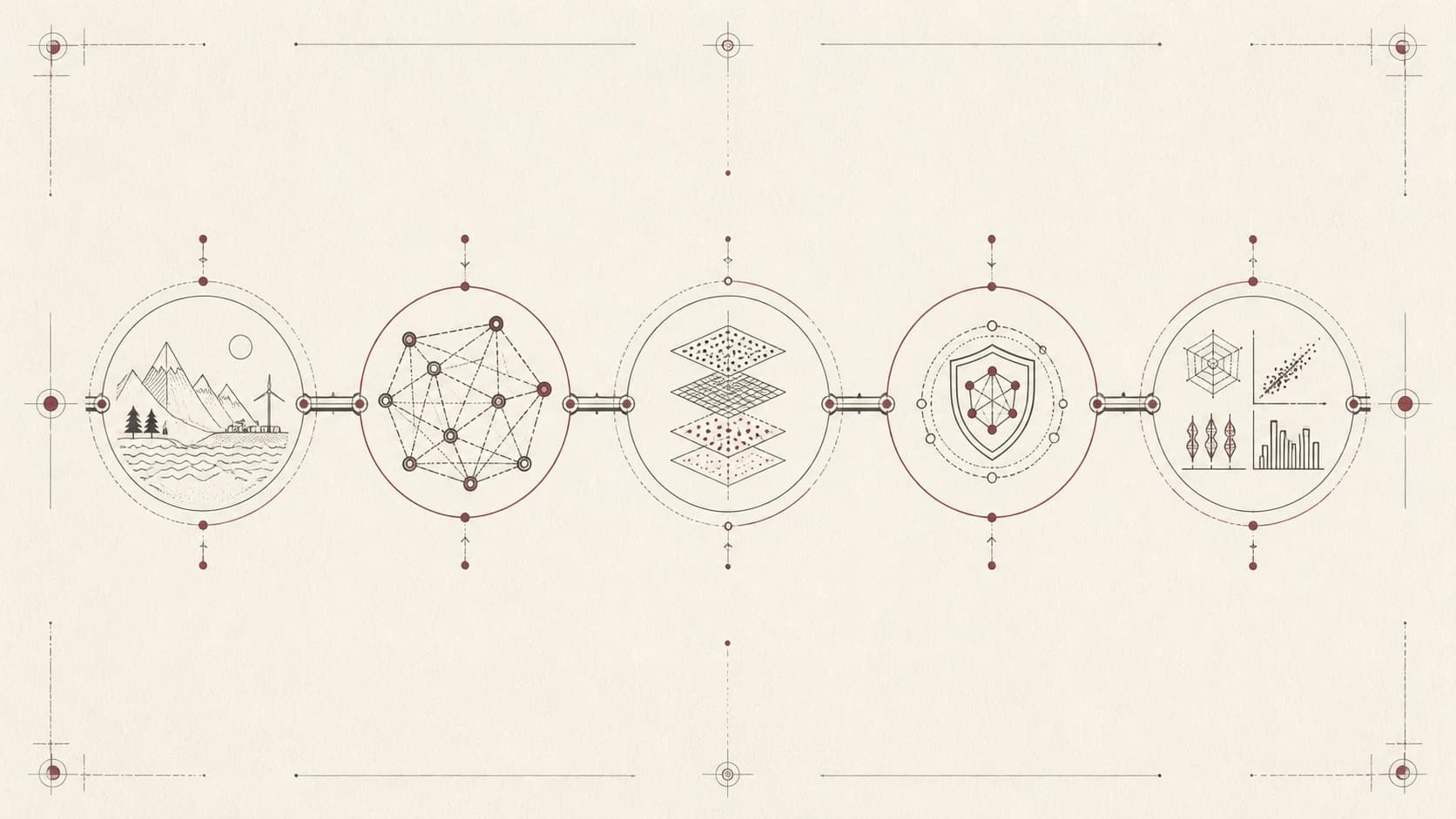
The survey work behind the doctoral thesis is useful here because it treats DFL as a system architecture rather than as a single training trick. A credible design answers five questions: who can communicate, what is exchanged, how contributions are combined, how unreliable behavior is handled and which metrics define success.
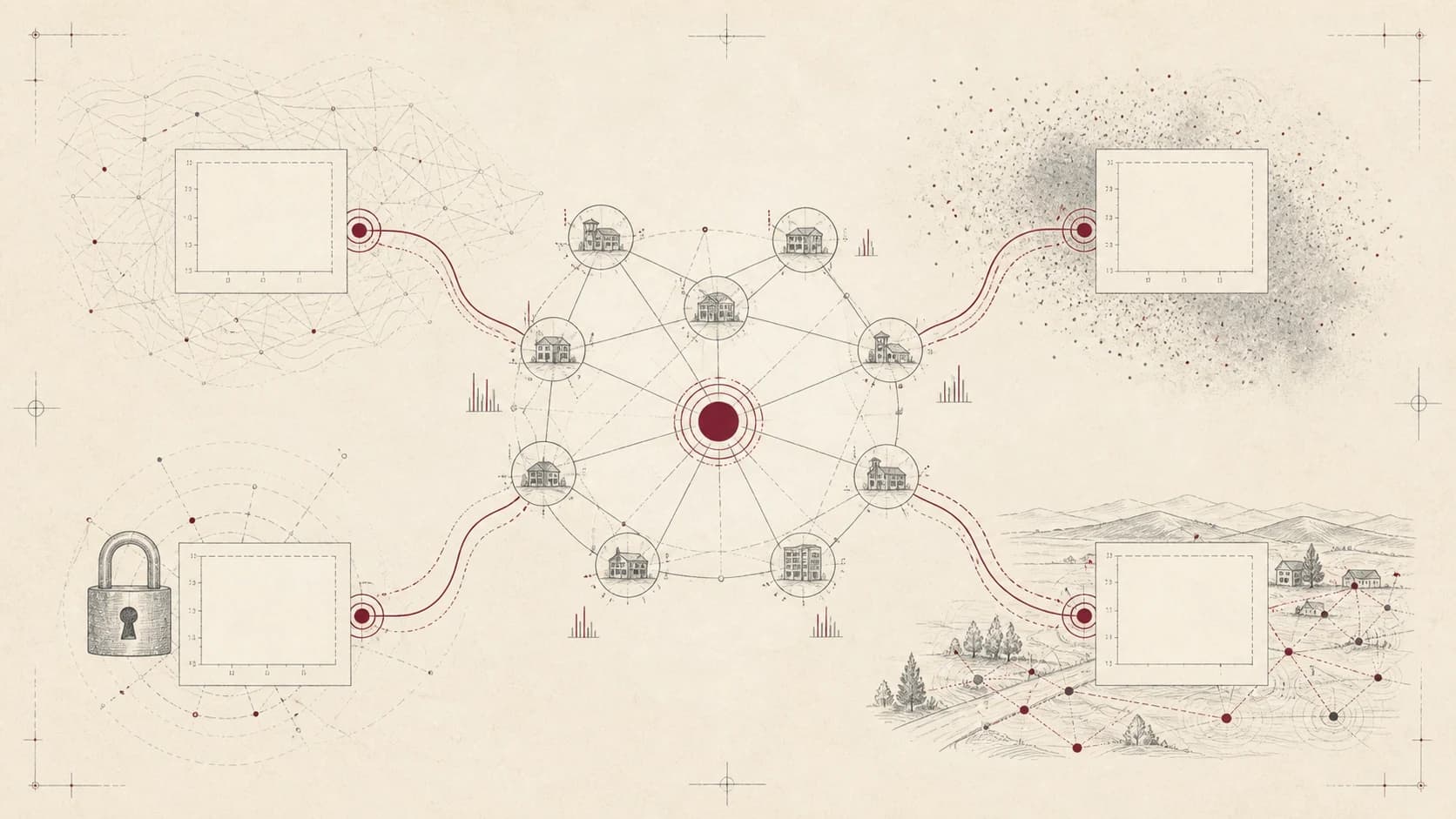
1. Start with the operating environment
List the properties that are fixed and the properties that may change:
- device capabilities and energy limits,
- link bandwidth, latency and availability,
- whether participants are static or mobile,
- the degree of statistical heterogeneity between local datasets,
- the sensitivity of the information represented by an update,
- the consequences of a delayed or malicious contribution.
This inventory prevents a common mistake: selecting a topology first and discovering later that it assumes links, memory or trust relationships that the environment does not provide.
2. Treat topology as a control surface
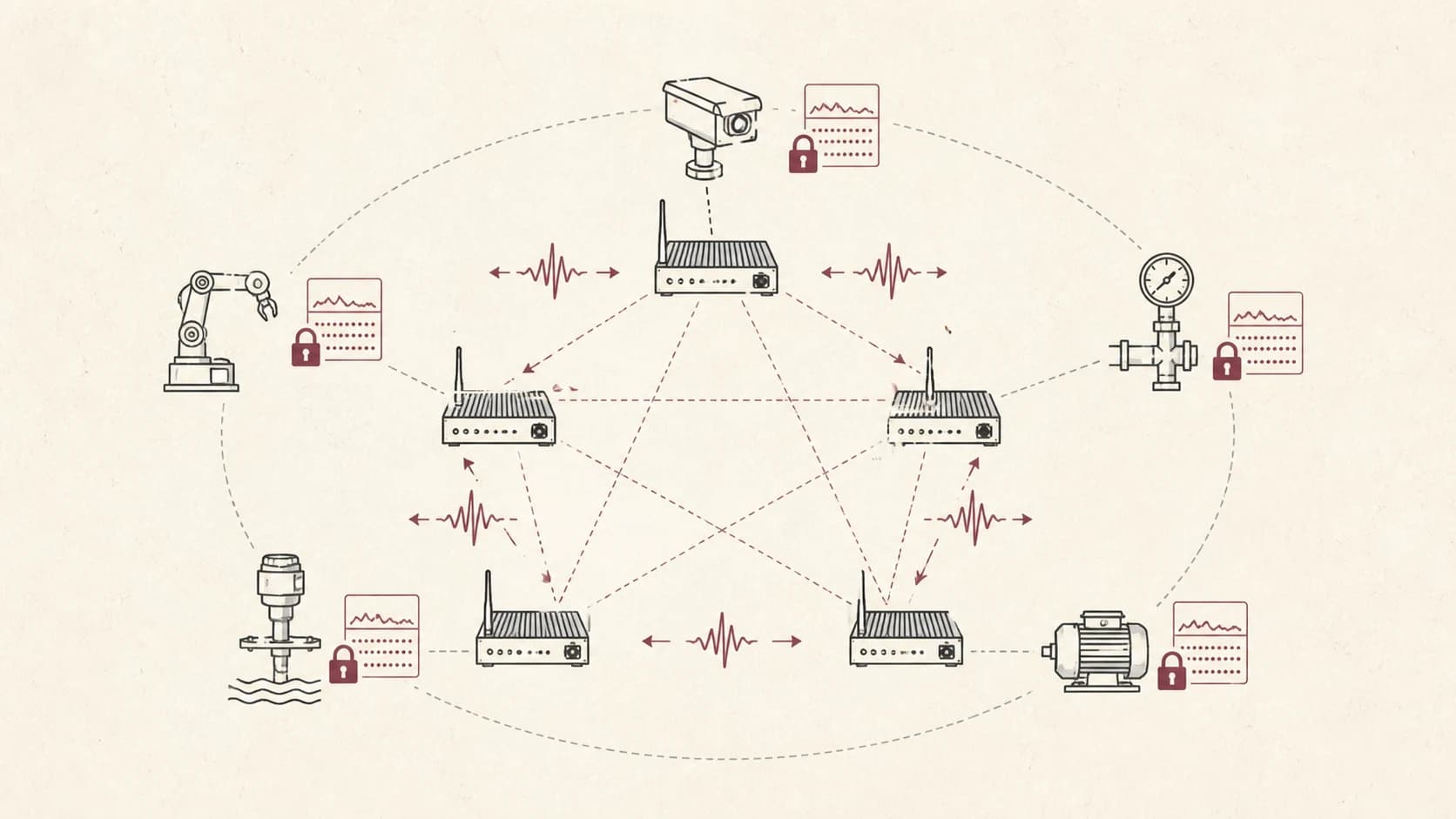
A ring is simple and inexpensive, but information may need several hops to reach the whole network. A dense mesh spreads updates quickly, at the cost of more traffic and more opportunities to receive a bad update. A random graph can offer a useful compromise, but its properties depend on connectivity and on how neighbors change over time.
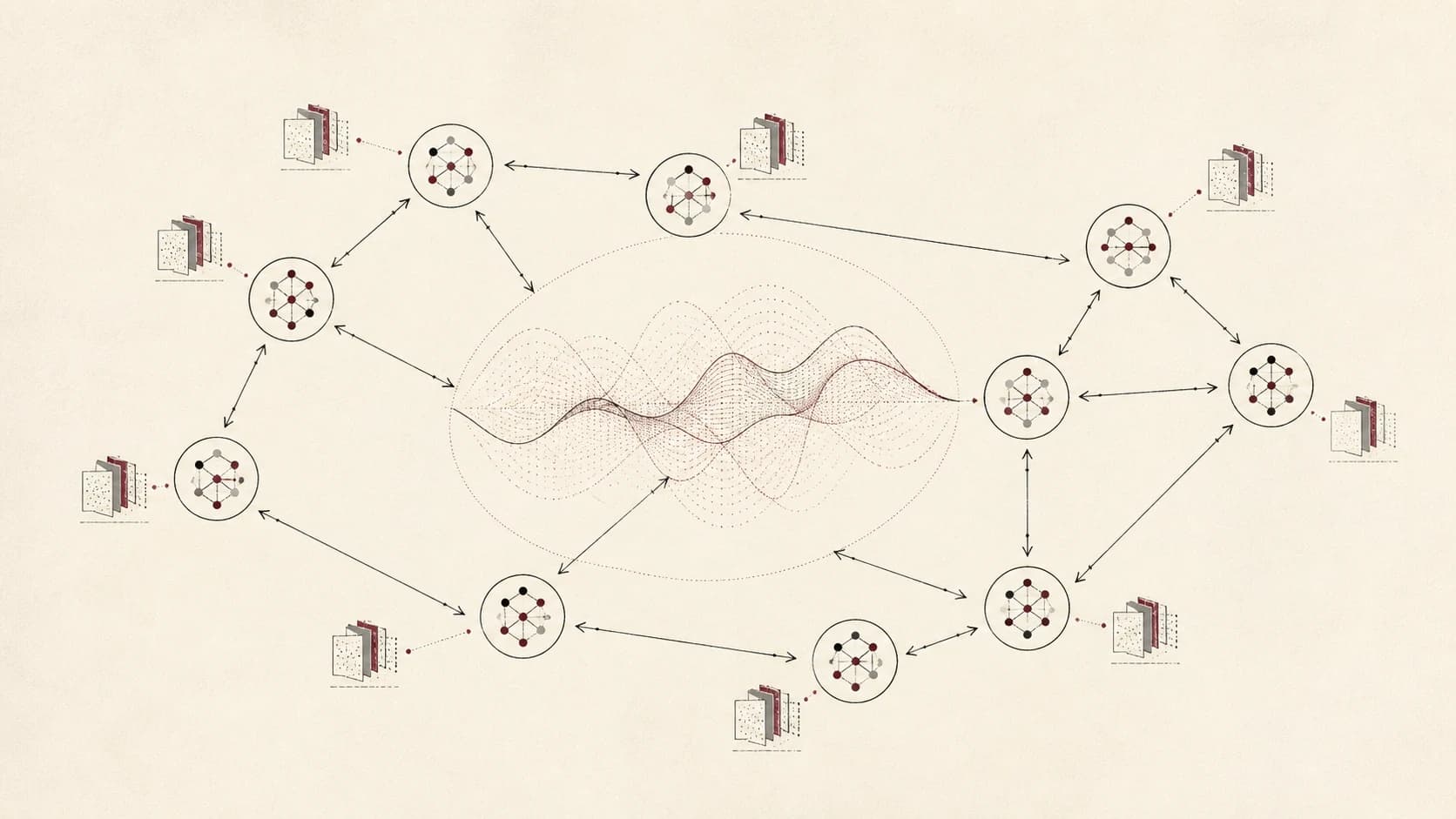
The relevant quantity is not only the number of edges. It is how the graph shapes the mixing of local models. If is a row-stochastic mixing matrix at round , a simplified consensus step is:
If the formula does not fit, focus it and use the left and right arrows, or scroll horizontally.The matrix can change as nodes move, fail or update their neighbor lists. In a real deployment, topology monitoring belongs in the learning loop because a connectivity change can also change the training dynamics.
3. Choose the exchanged representation deliberately
Full model parameters are expressive but expensive. Gradients can be smaller in some protocols, although they remain sensitive to optimization and privacy choices. Compact class or modality prototypes can make communication more targeted when the goal is to align representations rather than to copy an entire model.
The right representation depends on what peers need to learn from one another. A security detector may require update direction and confidence. A multimodal classifier may benefit more from a small summary of class-specific embeddings. The representation should be bounded, versioned and accompanied by enough metadata to interpret it safely.
4. Make robustness explicit
In a decentralized network, a contribution can be wrong because a client has noisy data, because its model is stale or because an adversary is manipulating it. These cases should not be treated as identical. A useful protocol records provenance and can combine several signals before deciding how much influence a contribution receives.
One conceptual influence rule is:
If the formula does not fit, focus it and use the left and right arrows, or scroll horizontally.where represents model consistency, contextual agreement and recent reliability. The expression is a design pattern, not a universal formula. The important property is bounded influence and a visible reason for changing it.
5. Evaluate more than final F1
A DFL experiment should report model quality together with the conditions that produced it. Useful dimensions include:
| Dimension | Example question |
|---|---|
| Quality | Does the model generalize beyond the best-connected clients? |
| Communication | How many bytes move per client and per round? |
| Convergence | How quickly does the network reach a stable level? |
| Robustness | What happens when a peer is stale, noisy or adversarial? |
| Resources | Can the devices sustain CPU, memory and energy demands? |
| Topology | Does performance survive sparse or changing graphs? |
Reporting only the best accuracy hides the engineering trade-offs. The thesis uses this broader view to connect a state-of-the-art survey with controlled studies of dynamic reliability and multimodal heterogeneity.
A compact design checklist
Before implementing, specify:
- the threat model and the failure modes that matter;
- the graph policy and how neighbors are discovered;
- the representation exchanged at each step;
- the rules for weighting, rejecting or quarantining updates;
- the privacy assumptions and leakage tests;
- the metrics, datasets and topology variations used for evaluation;
- the recovery path when the network cannot reach consensus.
Decentralization is valuable when it matches the environment. A topology that removes a server but silently creates a fragile chain of dependencies is not a robust design. The goal is a system whose learning, networking and security assumptions can be inspected together.
Turn the checklist into a message contract
A minimal message proposal should identify the authenticated sender, experiment, model version, representation schema, originating round and expiration. The receiver validates dimensions, finite values and duplicates before aggregation. A correctly shaped tensor can still be harmful; format validation and statistical validation are different layers.
Specify behavior for incorrect sample weights or incompatible versions. When weights are normalized after filtering neighbors, check that a single contribution cannot accumulate all influence. Having no valid neighbors requires an explicit transition.
A mixing-matrix detail that changes the objective
Rows of summing to one do not imply preservation of the uniform average. In a directed network, some nodes can have greater influence on the stationary state. The algorithm must justify its weights or use an appropriate correction mechanism. Work on decentralized SGD with changing topology demonstrates the importance of explicit mixing conditions.
A proposed test before scaling
Use the same data partition in a dense and a sparse topology. Then introduce disconnection and rejoining while preserving versions and seeds. Measure model disagreement, cumulative bytes, time to target quality and worst-client performance. An average-only improvement can hide information isolation.
The 2023 DFL survey maps the design space. For two other concrete decisions, see Byzantine aggregation and prototype communication.