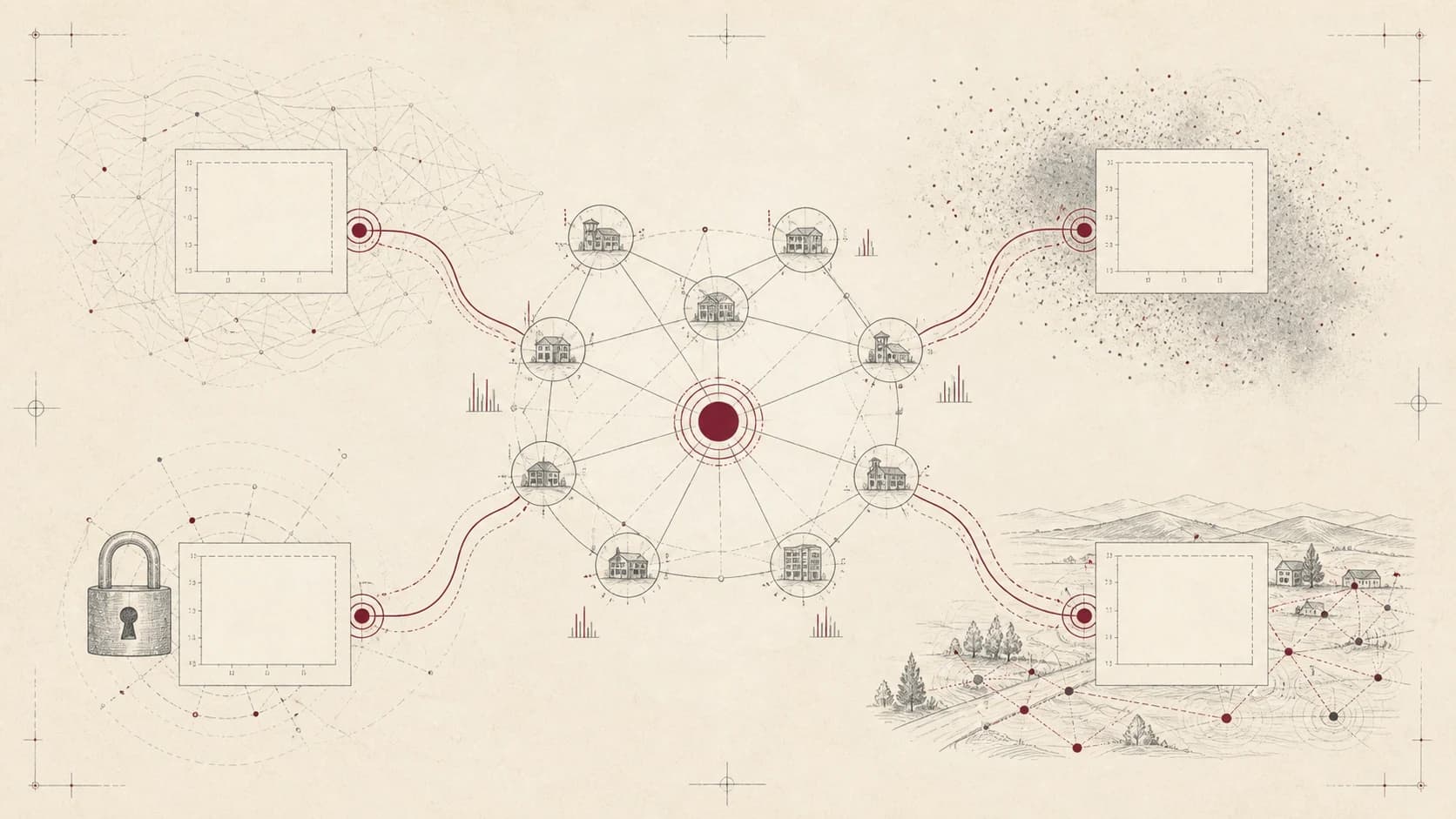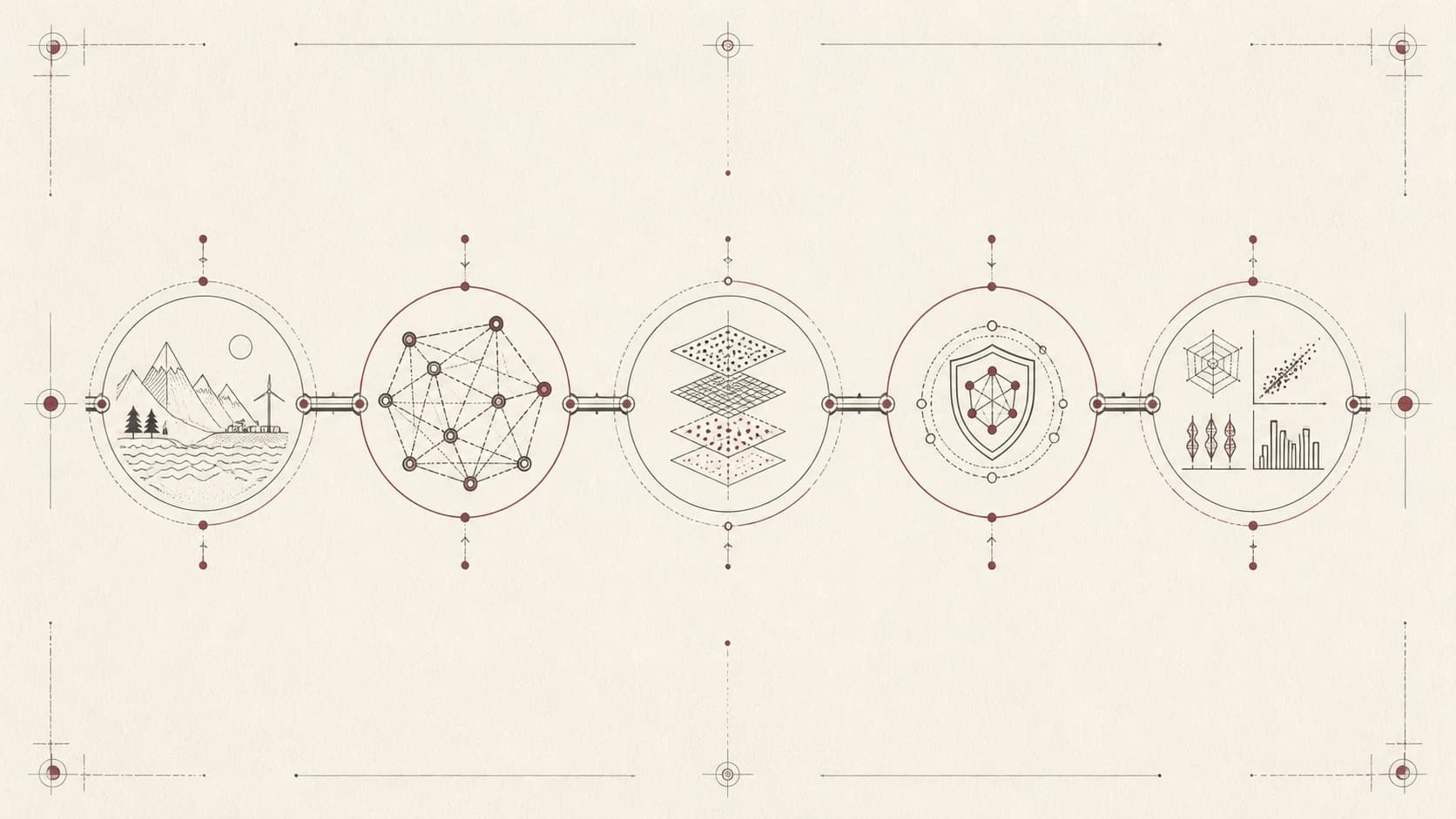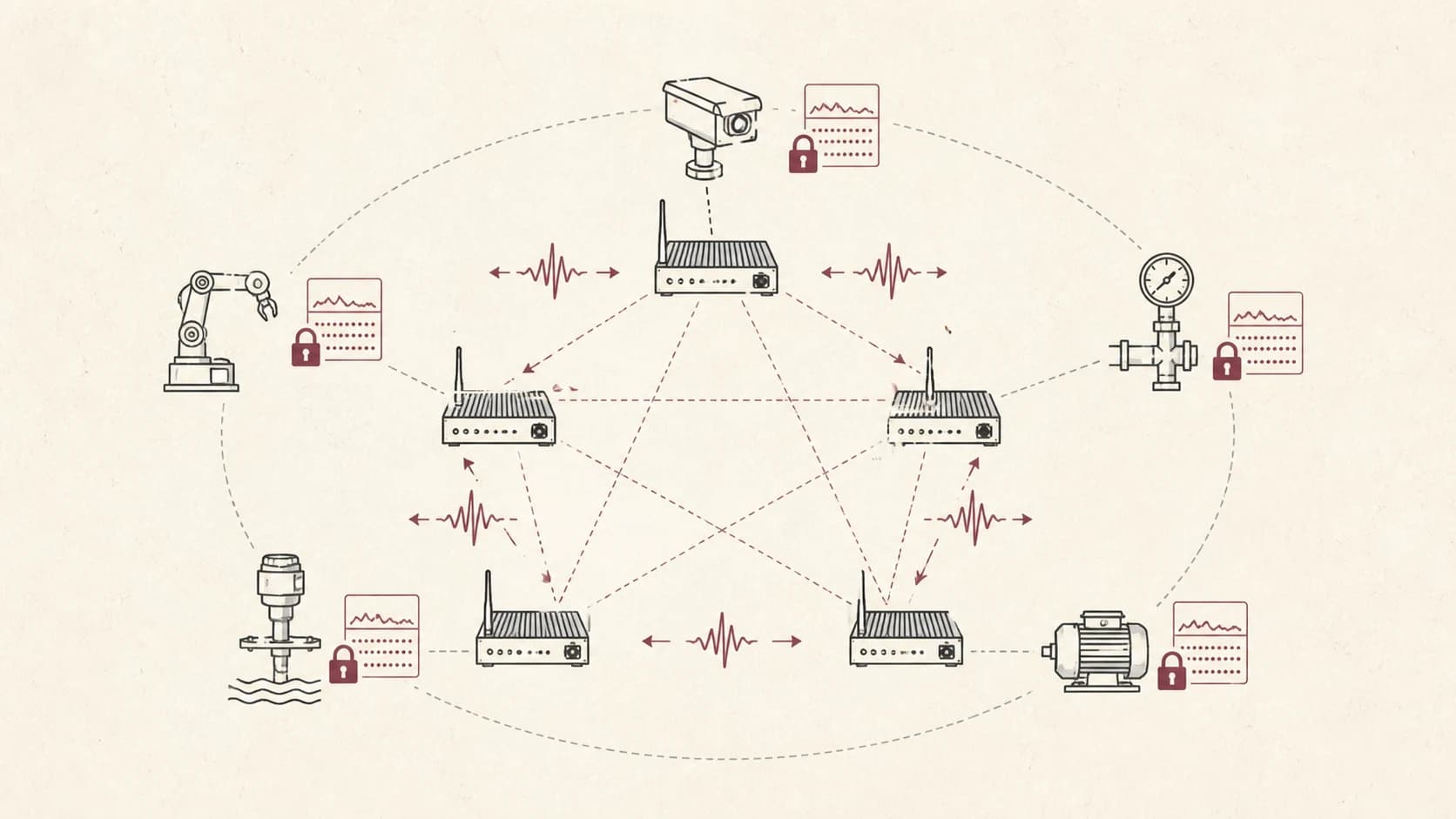
Differential privacy, secure aggregation and robust aggregation protect different properties of a federated system. Combining them requires checking what information each mechanism needs and what an earlier mechanism hides. A list of enabled techniques does not establish compatible guarantees.
In DFL, the question becomes harder because participants may observe different neighborhoods. This article proposes a design and evaluation approach, without claiming a cryptographic implementation or new experimental results.
What each mechanism protects
| Mechanism | Question addressed | Property it does not provide alone |
|---|---|---|
| Transport encryption | Who can read the channel? | Honesty of the receiving participant |
| Secure aggregation | Is an individual contribution hidden during aggregation? | Robustness to malicious contributions |
| Differential privacy | How much does output change for one data unit? | Data authenticity or absence of poisoning |
| Robust aggregation | How is anomalous contribution influence limited? | Update confidentiality |
Bonawitz and colleagues' protocol and Abadi and colleagues' private training reference different properties. Their assumptions must be documented alongside the architecture and adversary of a concrete deployment.
The tension between hiding and inspecting
A defense may need distances between individual updates to identify outliers. If another mechanism reveals only a sum, that information is unavailable. Filtering cannot be assumed to behave identically after its inputs are hidden.
Possible design directions include inspections compatible with secure computation, prior validation, group aggregation or defenses using different evidence. Each changes the trust model. Grouping participants, for example, can reduce defense resolution and change relevant collusions. The choice requires an explicit protocol rather than simply executing two modules sequentially.
Define the protected unit and adversarial view
Before publishing an epsilon, specify whether an example, person, device or entire client is protected. In telemetry, many records can belong to one device. A record-level guarantee does not automatically become device-level protection.
Also describe whether the adversary observes one message, multiple rounds, colluding nodes, metrics or membership changes. Privacy accounting must include relevant releases. Sending cadence and metadata can expose information absent from the protected tensor.
Local robustness and non-IID data
The global malicious fraction does not determine the fraction visible to each node. A small neighborhood can concentrate an adversary. Record local support before and after filtering and behavior when it becomes insufficient.
Include legitimate clients with different data too. A defense that consistently removes their contributions may appear more stable while harming rare-class representation. Yin and colleagues study median and trimmed mean under statistical conditions; transferring conclusions requires checking those conditions.
A factorial evaluation protocol
I propose comparable configurations: a baseline without extra mechanisms, privacy alone, robustness alone and their combination. Preserve partition, topology and tuning budget. Repeat with clean data and a defined laboratory attack.
Record per-client quality, false rejection, bytes, time, observed disclosure and formal guarantees where available. An empirical failure to reconstruct data does not prove differential privacy. Conversely, a privacy guarantee does not establish utility or poisoning resistance.
Include disconnections and small participant sets. If a protocol requires a minimum threshold, verify that it stops or enters the specified fallback when that threshold is not met. Silently continuing may invalidate the assumption protecting contributions.
A recent direction: adding compression
Li and colleagues, AISTATS 2026 investigate compressed communication in Byzantine distributed learning. The work connects efficiency and robustness; it does not automatically validate differential privacy, secure aggregation or multimodal DFL protocols.
As a next experiment, study whether quantization and noise change a distance-based defense. Compare the combination with each transformation alone. Thresholds calibrated on noiseless updates may reject too much when the legitimate distribution changes.
A verifiable claim
A useful conclusion can state which unit is protected, against which observer, over how many releases, what neighborhood the protocol tolerates and what overhead it introduces. Avoid reducing this to “federated and private” or “attack-resistant” without those conditions.
The FL privacy foundations, Byzantine aggregation guide and prototype communication analysis develop the components separately. The research step is demonstrating which properties survive their combination.