In this article
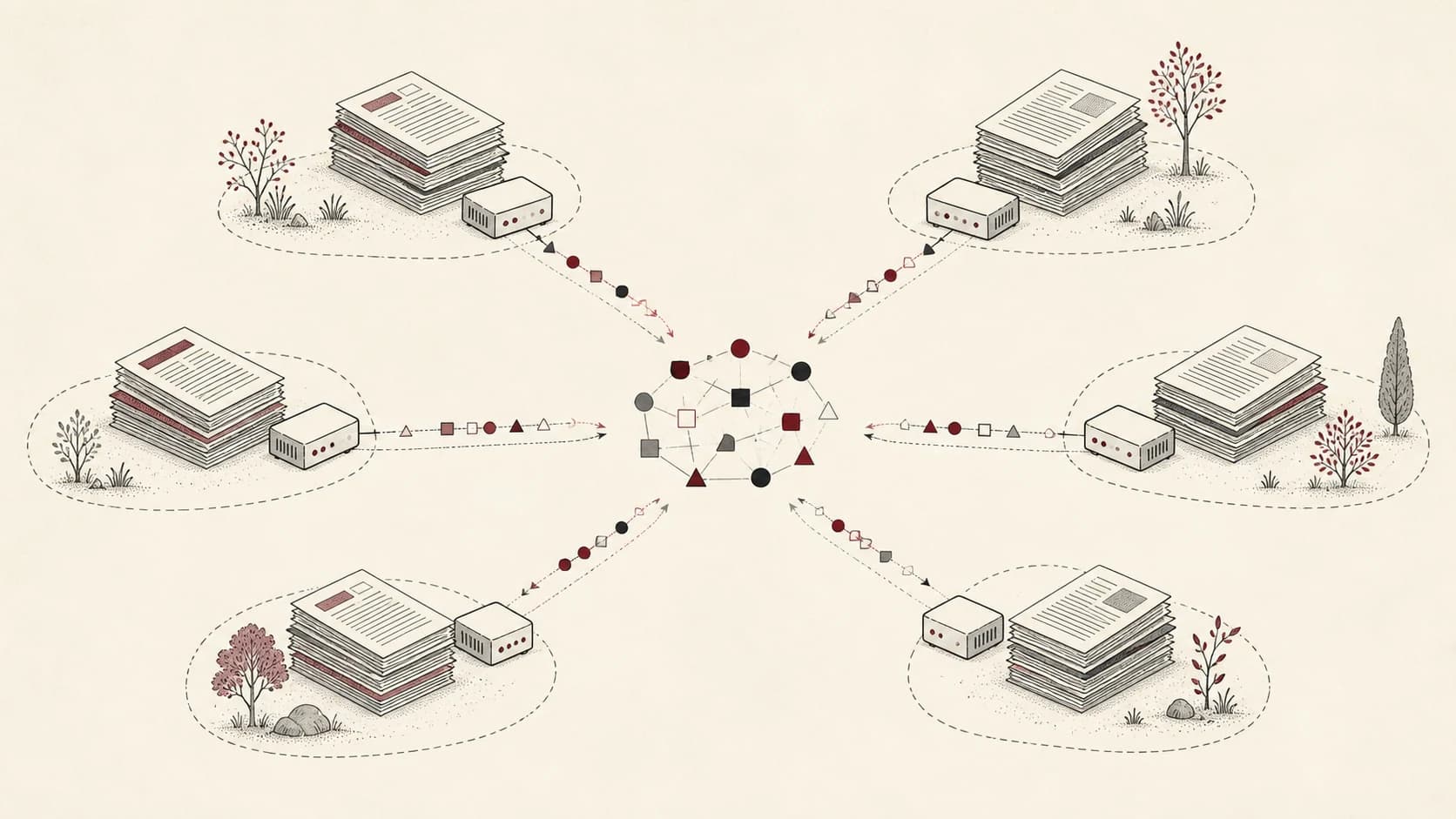
Federated learning is often introduced through a simple image: several clients train locally and send updates to a server. That picture is useful, but it is not the whole design space. Decentralized federated learning (DFL) changes who coordinates the collaboration, how information travels and where trust is placed.
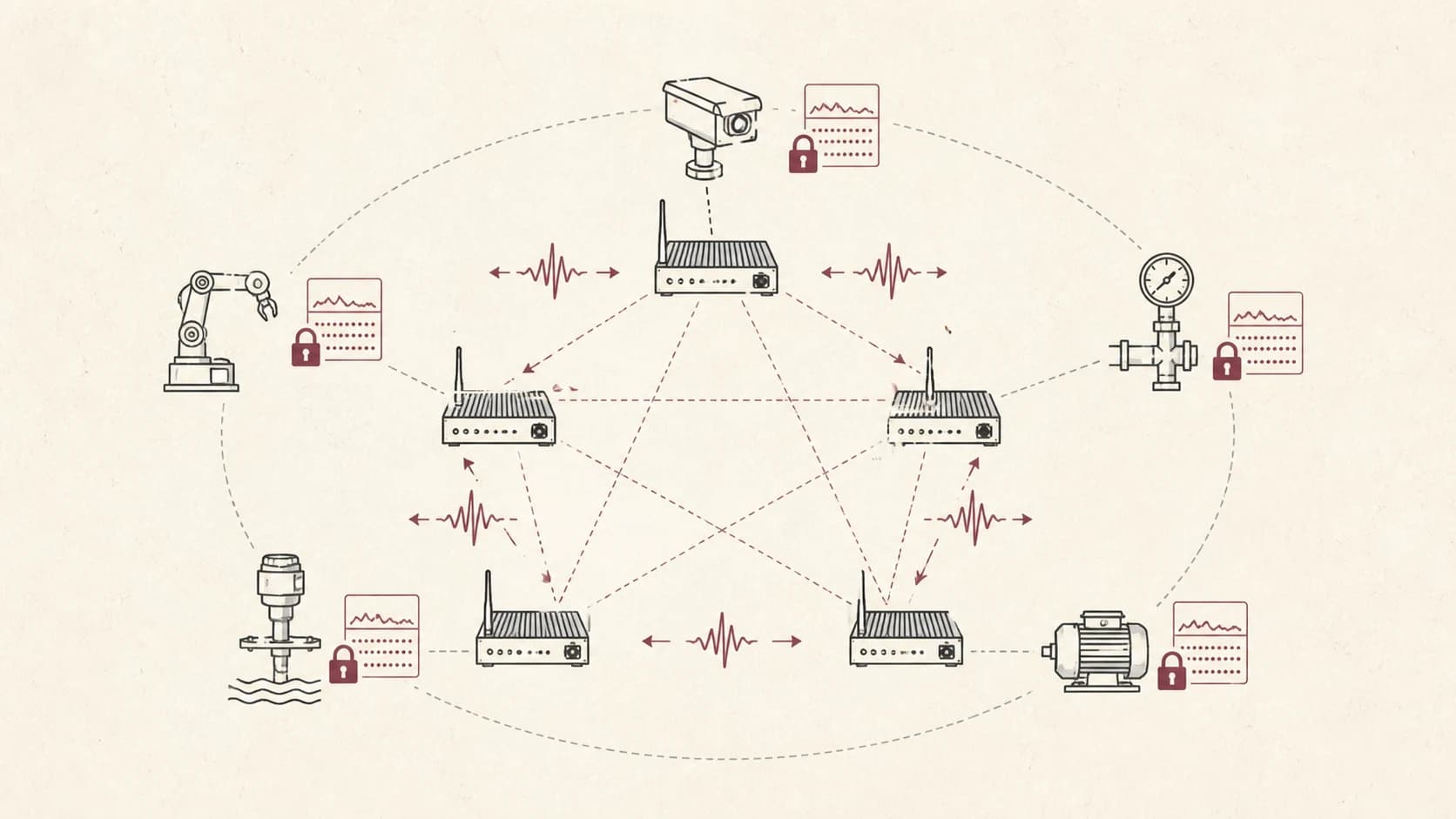
The distinction matters in environments where a permanent coordinator is impractical, too attractive as a target or incompatible with the way the system is operated. A fleet of devices, a group of edge nodes or a set of mobile platforms may need to learn together while remaining connected only to nearby peers.
The server is not the only difference
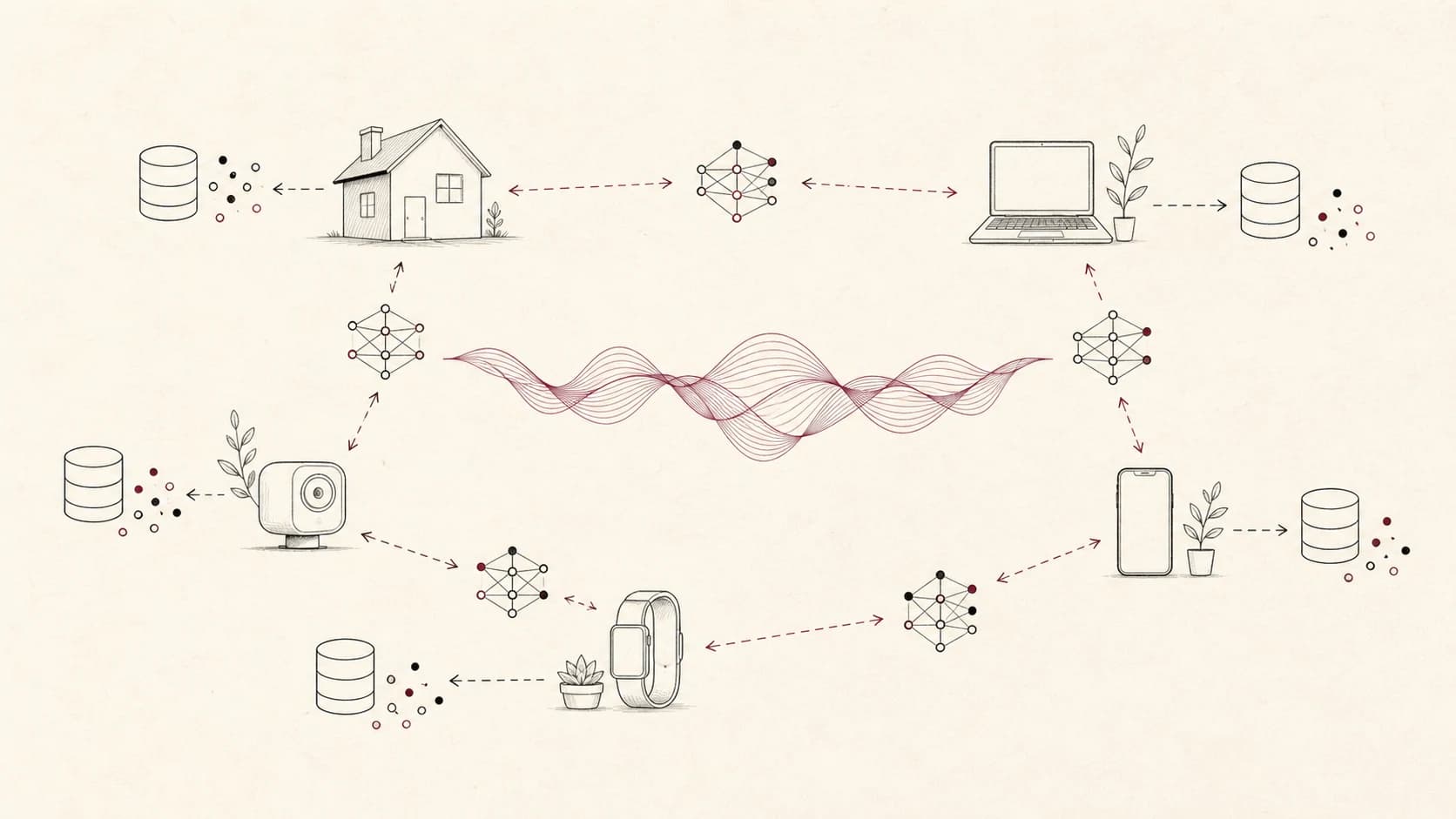
In a centralized federation, the server typically receives updates, computes an aggregate and broadcasts the next model. DFL distributes some of those responsibilities across the participants. Nodes exchange information with neighbors, apply local training and take part in a protocol that must keep the network moving towards a shared model.
An abstract local step can be written as:
If the formula does not fit, focus it and use the left and right arrows, or scroll horizontally.where is the data kept by participant , is its current neighborhood and describes how much influence a peer has at round . This is an explanatory model rather than a single DFL algorithm. Its value is that it makes the design responsibility visible: learning and coordination are now coupled to the network.
Four consequences of decentralization
1. Topology becomes part of the algorithm
In a server-based system, the logical communication pattern is relatively easy to describe. In DFL, a ring, mesh, random graph or changing neighbor set can alter how quickly information spreads and how resilient the collaboration is. Connectivity is not only an infrastructure concern. It affects convergence, staleness and the diversity of updates that each node sees.
2. Trust is distributed, not removed
Removing the server does not make participants trustworthy by default. A decentralized protocol still needs to decide which updates to accept, how to limit the influence of an unreliable peer and how to react when a node is compromised. Robust aggregation, reputation signals and connection policies become protocol components instead of optional extras.
3. Privacy and observability have to be balanced
Keeping raw data local reduces one important exposure, but exchanged models, gradients or prototypes can still reveal information. At the same time, a defense system needs enough context to identify drift, poisoning or a failing link. DFL therefore requires an explicit account of what is shared, with whom, for how long and for which decision.
4. Evaluation has more than one axis
Accuracy alone is not enough. A useful evaluation should report at least model quality, communication volume, convergence behavior, resource use, topology sensitivity and the effect of unreliable or adversarial participants. A model that scores well in a static laboratory graph may still be unusable when links disappear or local data distributions change.
A practical mental model
It is helpful to separate three layers:
- Local intelligence: data preparation, training and inference stay close to the source.
- Peer protocol: nodes exchange bounded information and agree on how the collaboration advances.
- Operational guardrails: the system monitors reliability, resource limits, privacy exposure and recovery paths.
The thesis behind this series studies these layers together. It first maps the DFL design space, then examines reliability in a dynamic aerial-reconnaissance setting, and finally explores compact prototype exchange when clients have heterogeneous or missing modalities. The common thread is that decentralization only becomes useful when the learning protocol and the operational context are designed as one system.
The right question to ask
Instead of asking whether DFL is automatically better than centralized federated learning, ask which dependency the architecture is trying to remove. Is the concern a single point of failure, data sovereignty, intermittent connectivity, governance or the cost of moving full models? The answer should determine the topology, the exchanged representation and the threat model.
DFL is not a slogan for deleting a server. It is a different coordination problem. Its promise comes from placing learning closer to the environment, while its difficulty comes from making every hidden assumption about communication, trust and heterogeneity explicit.
Robust Decentralized Federated Learning in Heterogeneous Environments* and its constituent publications. It is not a reproduction of the dissertation text.*
Consensus does not mean instantly identical models
Updates can take several rounds to propagate through a connected network. Clients retain different parameters during that interval. This can be compatible with the algorithm, but requires specifying which model is evaluated: each client's model, an average computed for analysis or a deployment candidate.
The DFL survey organizes architectural decisions. Analysis of changing topology and local updates helps distinguish learning and mixing under explicit assumptions. Connectivity in one round does not establish that all knowledge has already circulated.
A test for hidden centralization
As a design exercise, list the services involved: discovery, certificates, configuration, aggregation, metrics and recovery. Specify what happens when each stops responding. A central dashboard does not invalidate decentralized aggregation by itself, but its failure can remove observability.
Participant admission matters too. A network may distribute computation while retaining one membership authority. That can be appropriate, provided it is not mistaken for a property the system does not offer.
The useful artifact is a dependency and degraded-mode table: local inference available, collaboration suspended, membership blocked or metrics unavailable. This turns decentralization into something testable.
The DFL design guide develops the protocol, while NEBULA supports designing experiments around those dependencies.