Skip to content
Enrique Tomás Martínez Beltrán
HomeResearchPublicationsTeachingBlog
ENES
Contact
HomeResearchPublicationsTeachingBlog
ENES
Contact

Enrique Tomás Martínez Beltrán

Ph.D. student at the University of Murcia working at the intersection of federated learning, cybersecurity, and privacy-preserving AI for real-world systems.

  • Privacy Policy
  • Terms of Service
  • Accessibility Statement
  • GitHubopens in a new tab
  • LinkedInopens in a new tab
  • Google Scholaropens in a new tab
  • RGopens in a new tab
  • ORCIDopens in a new tab
  • Scopusopens in a new tab
  • DBLPopens in a new tab
  • Web of Scienceopens in a new tab

Enrique Tomás Martínez Beltrán. All rights reserved.

Back to top

This site uses cookies for analytics to understand how visitors interact with the content. No personal data is shared with third parties.

  1. Home
  2. Blog & Technical Notes
  3. NEBULA: A Platform for Decentralized Federated Learning
Federated LearningAIPrivacyDecentralized SystemsNEBULA

NEBULA: A Platform for Decentralized Federated Learning

Introducing NEBULA, a cutting-edge platform designed to facilitate the training of federated models within both centralized and decentralized architectures

Enrique Tomás Martínez Beltrán

Ph.D. Researcher in Federated Learning and Cybersecurity

March 13, 202512 min read
  • LinkedInopens in a new tab
  • Xopens in a new tab
NEBULA: A Platform for Decentralized Federated Learning

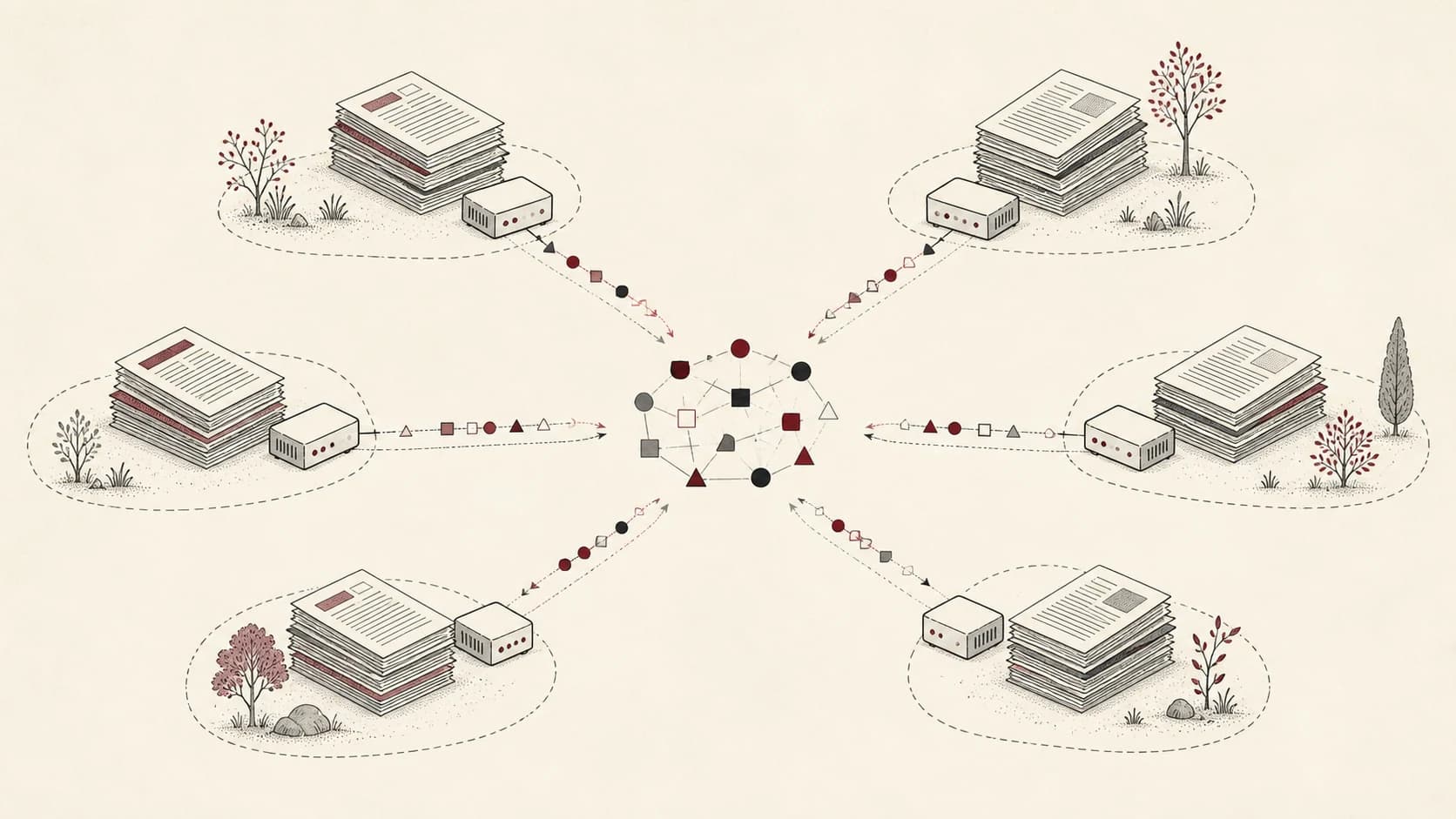
With the growing need for Artificial Intelligence (AI) solutions that can scale across large Internet of Things (IoT) networks while maintaining data privacy, the demand for federated learning platforms has never been greater. NEBULA emerges as a powerful open-source platform designed to facilitate decentralized federated learning (DFL) across a variety of physical and virtualized devices.

NEBULA provides a standardized approach for developing, deploying, and managing federated learning applications efficiently. It allows organizations, researchers, and developers to train AI models collaboratively without centralizing data, thereby enhancing privacy, security, and scalability.

🔗 Accessing NEBULA

NEBULA is open-source and publicly available:

  • GitHub Repository: NEBULA GitHub
  • Documentation: NEBULA Docs
  • Production Deployments: nebula-dfl.com | nebula-dfl.eu

What is Decentralized Federated Learning?

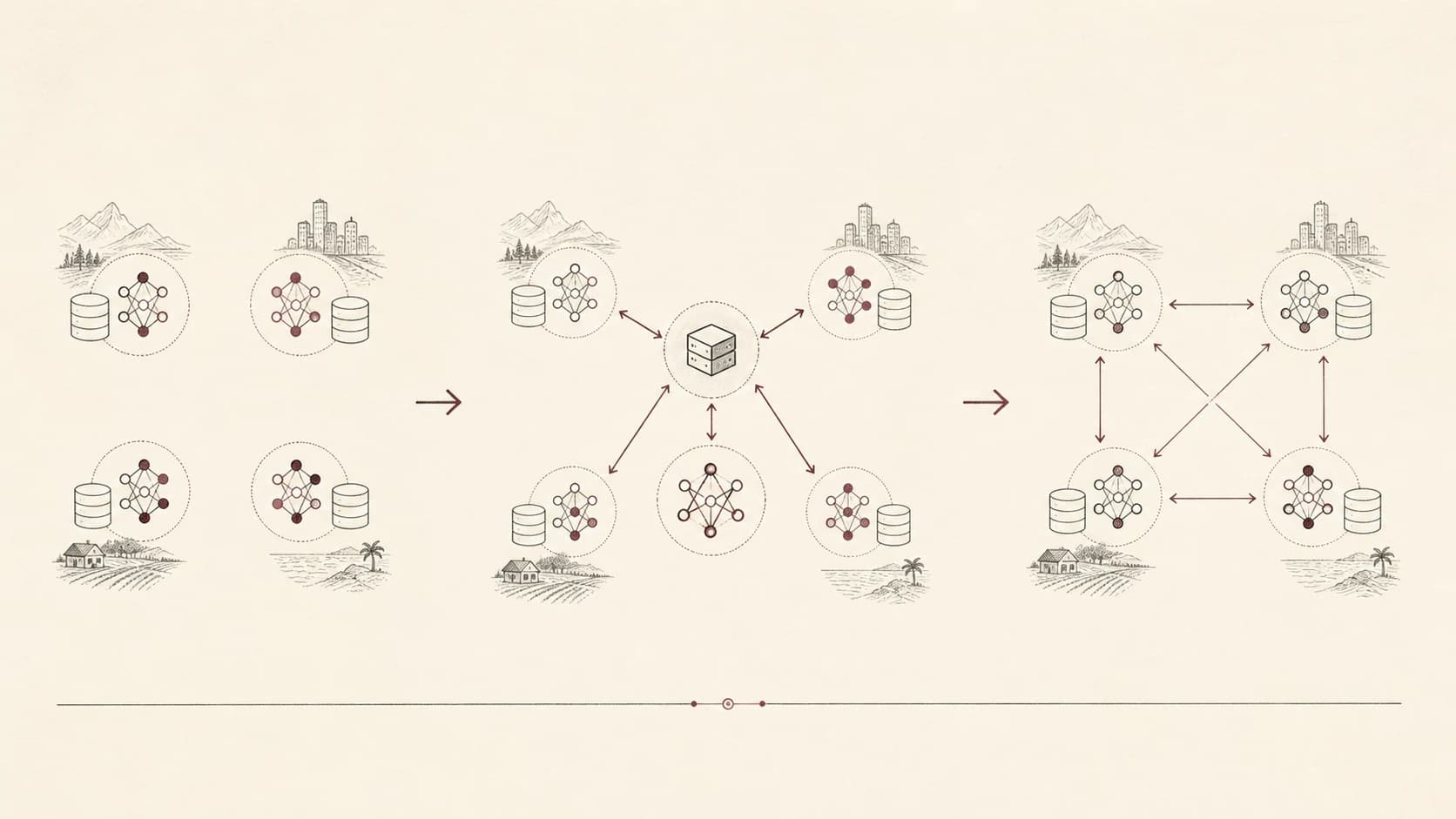
Decentralized Federated Learning is a federated system where communications are decentralized among network participants, eliminating the need for a central server. This approach offers several advantages:

  • Enhanced Privacy: Data remains on local devices
  • Improved Scalability: No single point of failure
  • Reduced Communication Costs: Direct peer-to-peer communication
  • Increased Trust: No reliance on central authority

Mathematical Foundations

Traditional Federated Learning

In traditional federated learning, the global model update is commonly expressed as:

θt+1=θt−η∑i=1N(∣Di∣∣D∣)∇Li(θt)\theta_{t+1} = \theta_t - \eta \sum_{i=1}^{N} \left(\frac{|D_i|}{|D|}\right) \nabla L_i(\theta_t)θt+1​=θt​−ηi=1∑N​(∣D∣∣Di​∣​)∇Li​(θt​)

Where:

  • θt\theta_tθt​ is the global model at time t
  • η\etaη is the learning rate
  • DiD_iDi​ is the local dataset of client i
  • LiL_iLi​ is the loss function for client i

Decentralized Approach

In DFL, each node updates its model using a peer-aware consensus step:

θi(t+1)=θit−η∇Li(θit)+α∑j∈NiWij (θjt−θit)\theta_i^{(t+1)} = \theta_i^t - \eta \nabla L_i(\theta_i^t) + \alpha \sum_{j \in \mathcal{N}_i} W_{ij}\,(\theta_j^t - \theta_i^t)θi(t+1)​=θit​−η∇Li​(θit​)+αj∈Ni​∑​Wij​(θjt​−θit​)

Where:

  • Ni\mathcal{N}_iNi​ is the neighborhood of node i
  • WijW_{ij}Wij​ is the mixing weight between nodes i and j
  • α\alphaα is the consensus parameter

🏗️ NEBULA Architecture

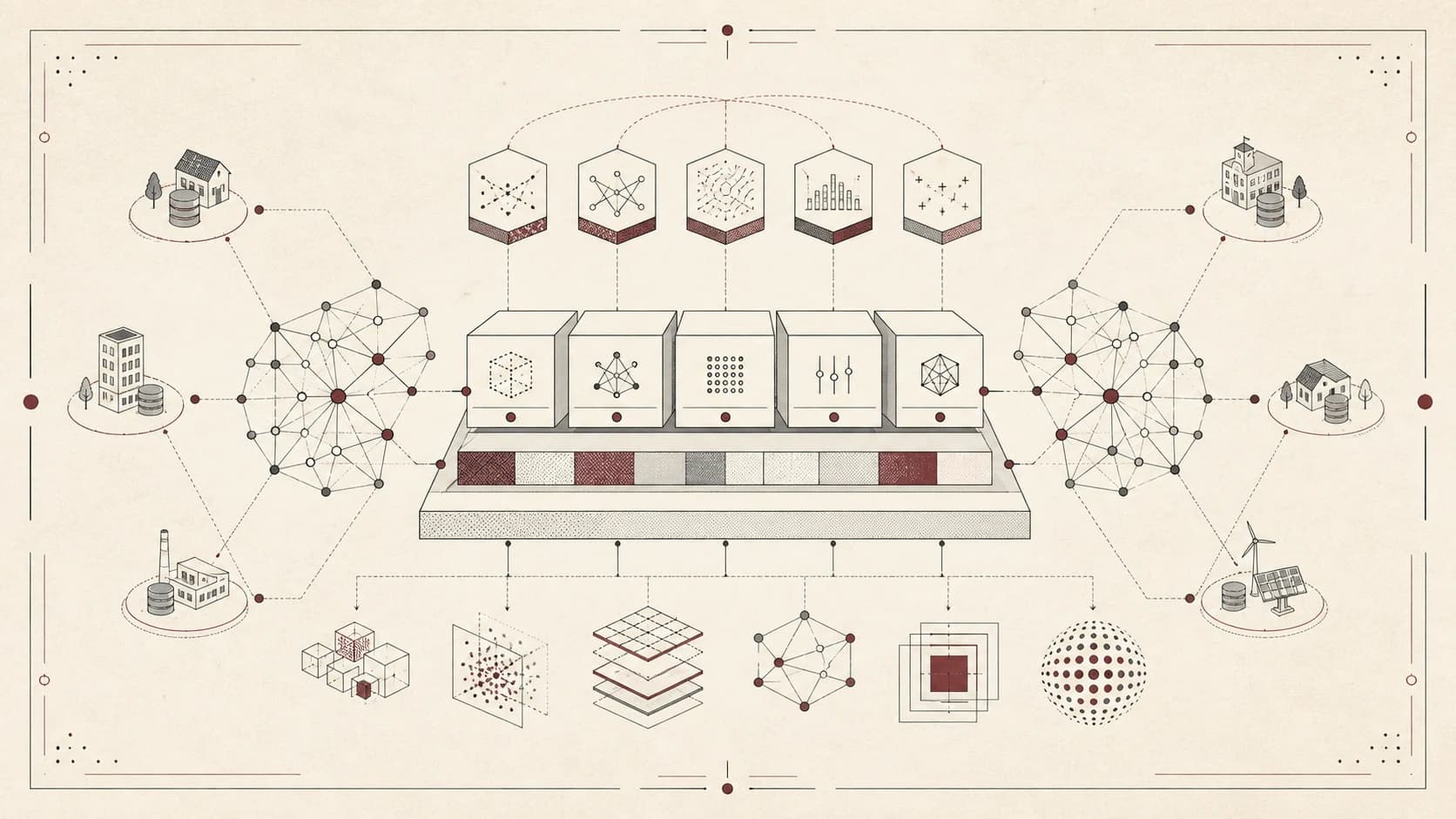
NEBULA is structured into four main components, each playing a crucial role in the federated learning process:

🧑‍💻 User

  • Manages the entire federation process via an intuitive frontend.
  • Configures, monitors, and adjusts federated scenarios based on system requirements.

🎨 Frontend

  • A user-friendly dashboard for designing, managing, and tracking federated learning processes.
  • Provides real-time monitoring of key performance indicators (KPIs).

🎛️ Controller

  • Acts as the orchestration engine, interpreting user commands.
  • Manages the entire federated learning scenario, including learning algorithms, datasets, and network topology.

🖥️ Core

  • Deployed on each participating device in the federation.
  • Responsible for model training, data preprocessing, and secure communication.
  • Computes KPI metrics and sends updates back to the frontend.

🏗️ Additional Modules

Beyond its core components, NEBULA includes tools for federation management, performance tracking, and network optimization, ensuring seamless and efficient federated learning deployments.

🔑 NEBULA Core Modules

NEBULA's Core is composed of several key modules:

  • Network: Manages communication, data exchange, and secure federated interactions.
  • Models: Implements various deep learning architectures (e.g., MLP, CNN, ResNet) compatible with federated learning.
  • Datasets: Supports multiple data partitioning strategies (IID & non-IID) for flexible experimentation.
  • Aggregation: Provides aggregation strategies such as FedAvg, Krum, Median, and Trimmed Mean to securely combine local model updates.

NEBULA also extends its capabilities with additional add-ons:

  • Attacks: Simulate security threats like model poisoning, label flipping, and adversarial attacks.
  • GPS: Enables location-aware federated learning to optimize model training in dynamic environments.
  • Network Simulation: Simulates real-world network conditions, including latency and failures.

Applications in Different Domains

Healthcare

NEBULA enables collaborative medical AI without sharing patient data:

Python
class NebulaMedicalDFL:
    def __init__(self):
        self.privacy_budget = 1.0
        self.secure_aggregation = True
        
    def add_differential_privacy(self, gradients, noise_scale=0.1):
        """Add differential privacy noise to gradients"""
        noise = torch.randn_like(gradients) * noise_scale
        return gradients + noise
        
    def secure_aggregation(self, local_updates):
        """Perform secure aggregation of model updates using NEBULA's protocols"""
        # Implementation of secure aggregation protocol
        pass
        
    def healthcare_compliance_check(self, model_updates):
        """Ensure healthcare data compliance (NEBULA feature)"""
        # Check for HIPAA/GDPR compliance
        pass

IoT Security

For IoT device identification and security using NEBULA:

Python
class NebulaIoTDeviceFingerprinting:
    def __init__(self):
        self.feature_extractor = self.build_feature_extractor()
        self.location_aware = True  # NEBULA GPS feature
        
    def extract_device_features(self, device_data):
        """Extract unique device fingerprinting features"""
        features = []
        for data_point in device_data:
            # Extract hardware and behavioral features
            hw_features = self.extract_hardware_features(data_point)
            behavior_features = self.extract_behavioral_features(data_point)
            
            # Add location-aware features (NEBULA GPS module)
            if self.location_aware:
                location_features = self.extract_location_features(data_point)
                features.append(np.concatenate([hw_features, behavior_features, location_features]))
            else:
                features.append(np.concatenate([hw_features, behavior_features]))
        return np.array(features)
        
    def train_federated_model(self, local_features, device_labels):
        """Train federated model for device identification using NEBULA"""
        # DFL training implementation with NEBULA's security features
        pass

Security Considerations

Adversarial Attacks

NEBULA provides robust defense mechanisms against various attacks:

  1. Model Poisoning: Malicious nodes inject false gradients
  2. Data Poisoning: Adversaries manipulate training data
  3. Privacy Attacks: Attempts to extract private information

NEBULA Defense Mechanisms

Python
class NebulaDFLSecurity:
    def __init__(self):
        self.trust_scores = {}
        self.anomaly_detection = True
        self.blockchain_integration = False  # Optional NEBULA feature
        
    def detect_anomalies(self, model_updates):
        """Detect anomalous model updates using NEBULA's attack simulation"""
        # Implement anomaly detection with NEBULA's attack modules
        pass
        
    def robust_aggregation(self, updates, trust_scores):
        """Perform robust aggregation using NEBULA's trust mechanisms"""
        weighted_updates = []
        for update, trust in zip(updates, trust_scores):
            weighted_updates.append(update * trust)
        return np.mean(weighted_updates, axis=0)
        
    def blockchain_verification(self, model_updates):
        """Verify model updates using blockchain (NEBULA optional feature)"""
        if self.blockchain_integration:
            # Implement blockchain verification
            pass

Performance Evaluation

Convergence Analysis

The convergence rate of DFL in NEBULA depends on a bound of the form:

∥θit−θˉt∥≤Cρt\lVert \theta_i^t - \bar{\theta}^t \rVert \leq C \rho^t∥θit​−θˉt∥≤Cρt

Where:

  • θˉt\bar{\theta}^tθˉt is the average of all models
  • ρ\rhoρ is the spectral radius of the mixing matrix
  • CCC is a constant

Communication Efficiency

NEBULA reduces communication overhead by:

  • Eliminating central server bottleneck
  • Enabling direct peer-to-peer communication
  • Reducing total communication rounds
  • Implementing efficient network simulation

🌟 NEBULA Key Features

NEBULA offers an advanced federated learning experience with the following features:

✅ Decentralized: Train models without a central server, ensuring resilience and scalability.

🔐 Privacy-Preserving: Only model updates are shared—data remains on-device.

🌐 Topology-Agnostic: Supports various network topologies including star, ring, and mesh.

🤖 Model-Agnostic: Compatible with multiple machine learning algorithms, from deep learning to classical ML.

📡 Secure Communication: Ensures encrypted and efficient device-to-device interactions.

🛠️ Trust & Reliability: Implements trust mechanisms to verify participant reliability.

🔗 Blockchain Integration: Optional blockchain support for enhanced security & transparency.

🛡️ Security-First Approach: Protects against adversarial attacks and data leaks.

📊 Real-Time Monitoring: Live tracking of performance metrics during training.

🌍 Use Cases & Applications

NEBULA is designed to adapt to multiple industries, enabling federated learning across various domains:

🏥 Healthcare

  • Train AI models on medical devices like wearables, sensors, and smartphones.
  • Maintain patient data privacy while enabling collaborative AI research.

🏭 Industry 4.0

  • Deploy in smart factories with robots, drones, and IoT devices.
  • Optimize predictive maintenance and process automation.

📱 Mobile Services

  • Enhance AI models on smartphones, tablets, and mobile networks.
  • Personalize on-device learning without compromising user data.

🛡️ Military & Defense

  • Secure autonomous defense systems including drones and surveillance.
  • Enable mission-critical AI while preserving operational security.

🚗 Automotive & Transportation

  • Implement federated learning in autonomous vehicles, trucks, and drones.
  • Optimize real-time decision-making in connected car networks.

Challenges and Future Directions

Current Challenges

  1. Communication Overhead: Managing peer-to-peer communication
  2. Convergence Guarantees: Ensuring model convergence
  3. Security Vulnerabilities: Protecting against attacks
  4. Heterogeneity: Handling diverse data distributions

Emerging Trends

  • Blockchain Integration: Immutable record keeping (NEBULA feature)
  • Edge Computing: Local processing capabilities
  • Quantum-Resistant Cryptography: Future-proof security
  • Cross-Silo Federated Learning: Multi-organization collaboration

🌌 Conclusion

NEBULA represents a new era in federated learning by offering an open, scalable, and privacy-preserving solution for collaborative AI training. Its modular architecture, strong security mechanisms, and real-world applicability make it a powerful tool for researchers, industries, and developers.

Key insights from this exploration:

  • NEBULA eliminates central server dependency through decentralized architecture
  • Privacy is preserved through local data processing and differential privacy
  • Security mechanisms protect against adversarial attacks with trust-based systems
  • Real-world applications span multiple industries with location-aware capabilities
  • Blockchain integration provides additional security and transparency

As we continue to develop and refine DFL techniques with platforms like NEBULA, we move closer to a future where AI can be truly collaborative while respecting privacy and security concerns.

Join the NEBULA community and start building the future of decentralized AI today! 🚀

🔗 Explore NEBULA:

  • GitHub: NEBULA GitHub
  • Documentation: NEBULA Docs
  • Production Deployment: nebula-dfl.com | nebula-dfl.eu

Related Research

Federated Learning: Revolutionizing AI Without Compromising Privacy

January 29, 2024

Federated Learning: Revolutionizing AI Without Compromising Privacy

Explore how federated learning is transforming the AI landscape by enabling collaborative model training without sharing raw data, preserving privacy while advancing machine learning capabilities.

Decentralized Federated Learning: A New Era in Artificial Intelligence

September 15, 2023

Decentralized Federated Learning: A New Era in Artificial Intelligence

Explore the transformative world of decentralized federated learning, from its mathematical foundations to real-world applications in cybersecurity and beyond.