In this article
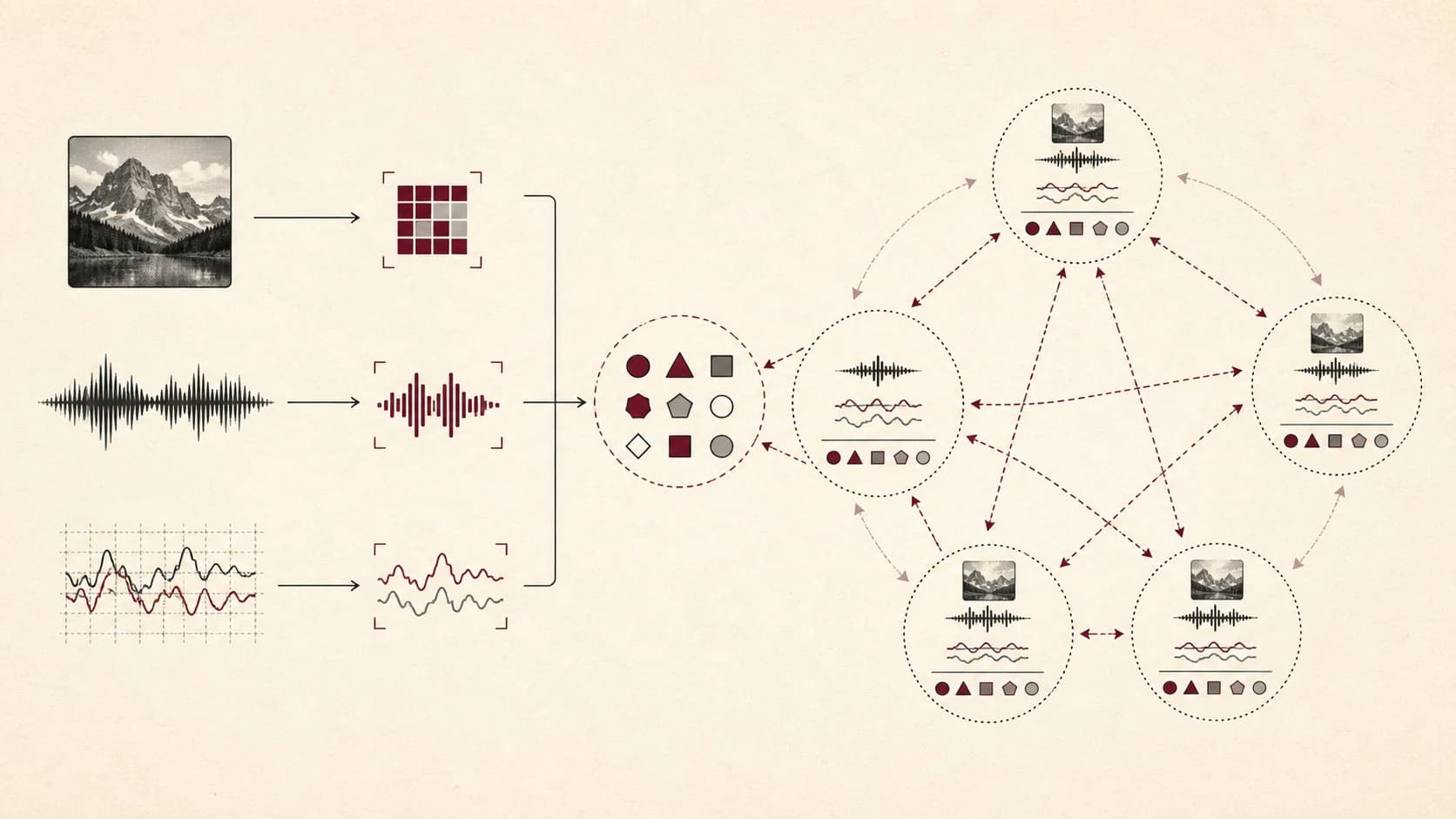
Federated learning usually assumes that clients solve the same task with comparable inputs. That assumption becomes fragile when one participant has images, another has audio and a third has only inertial sensors. The problem is not merely that the datasets are non-IID. The available modalities are different as well.
This setting appears in many forms: an audiovisual device with a broken microphone, a vehicle that has telemetry but no camera, or a crisis-monitoring client that receives text without an image. A useful decentralized system should keep learning when local views are incomplete rather than treating every client as if it had the same sensor suite.
Two kinds of heterogeneity
Statistical heterogeneity changes the distribution of classes or features across clients. A convenient way to think about it is a concentration parameter : smaller values mean that local data are more skewed and that the global label distribution is harder to reconstruct from any one participant.
Modality heterogeneity is different. A client may have a complete set of inputs, a subset or a modality that is temporarily unavailable. Let indicate whether client can observe modality . Its representation can be written as:
If the formula does not fit, focus it and use the left and right arrows, or scroll horizontally.The mask is important. Without it, a zero vector could mean a real observation, a missing sensor or a failed preprocessing step.
Why full-model averaging struggles
FedAvg-style averaging assumes that parameter updates are comparable enough to combine. With non-IID classes and missing modalities, a client can push the shared model towards a representation that is excellent for its local view but poorly aligned with the representations of other clients.
The failure may be hidden by the global mean. A well-connected multimodal client can dominate the average while a unimodal client receives a model whose internal features do not match its inputs. This is especially problematic when the client needs knowledge about a modality it cannot observe locally.
Prototype exchange as a different abstraction
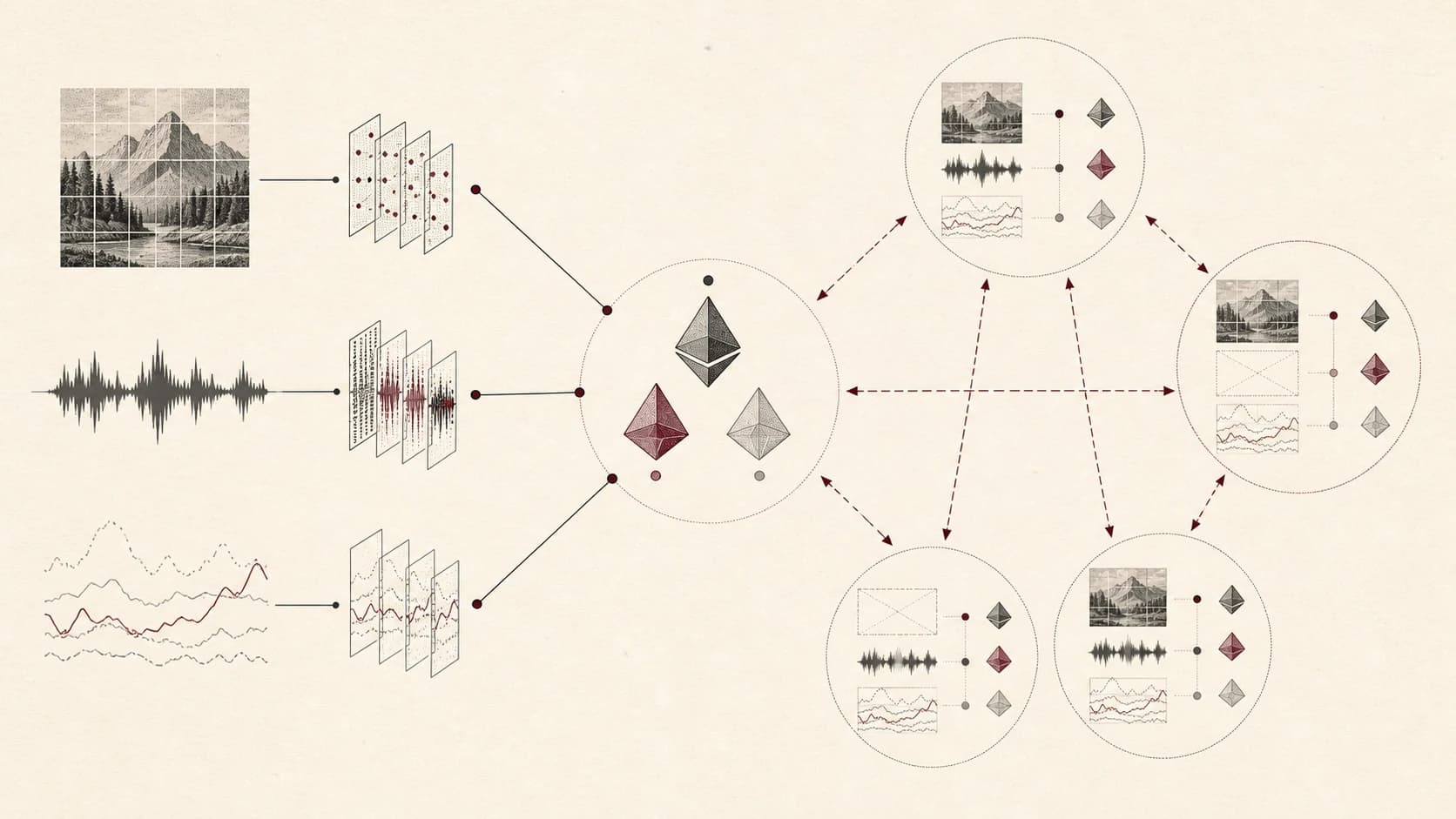
Instead of sending all parameters, a client can summarize class-specific representations. For class and modality , a local prototype may be expressed as:
If the formula does not fit, focus it and use the left and right arrows, or scroll horizontally.provided that the local set is non-empty. Peers can then align prototypes, transfer information between available and unavailable modalities and keep the private examples local. This does not solve every privacy issue, but it gives the protocol a compact semantic object to exchange.
The evaluation design
The Modalis study evaluates this problem with AVMNIST, CREMA-D, UCI-HAR and CRISIS-MMD. The datasets cover audiovisual digits, audiovisual emotion, inertial activity recognition and image-text crisis events. Class skew is controlled with , while missing-modality configurations use .
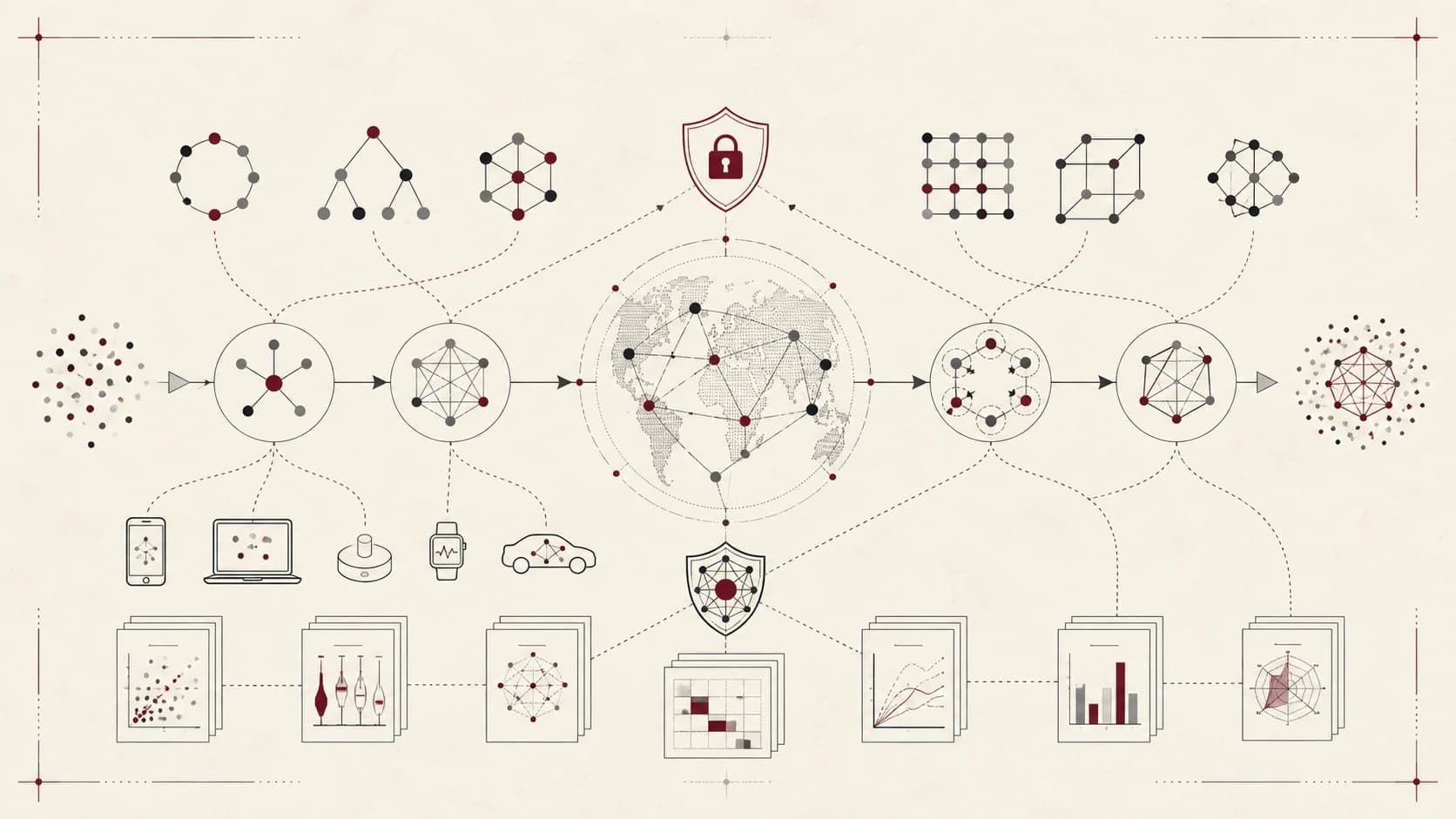
The principal experiments use 20 clients connected by a static Erdős-Rényi graph with . This detail matters: the results describe a controlled graph and should not be read as evidence that every topology behaves identically.
The central question is not whether a multimodal model can beat a unimodal one in a centralized benchmark. It is whether decentralized clients with different views can benefit from each other's representations without requiring a central fusion service.
What a robust multimodal protocol needs
A practical protocol should include:
- a mask or explicit representation for unavailable modalities,
- a fusion rule that can change the weight of each available modality,
- an alignment objective that keeps local and exchanged representations compatible,
- a fallback when a prototype is stale or absent,
- evaluation per modality configuration, not only a single global score.
It should also report the cost of this machinery. Multimodal robustness is not free, and a method that requires every client to exchange a full model may be impossible on a constrained link.
The research lesson
Heterogeneous multimodal DFL is a coordination problem about partial views. The objective is not to pretend that every participant sees the same world. It is to make the differences explicit, summarize useful knowledge in a controlled representation and let each client benefit from information that is unavailable locally.
That perspective connects non-IID learning, missing sensors and communication efficiency. It also gives a clearer route to future work: dynamic modality availability, real topology changes, cross-dataset transfer and formal analysis of what a prototype can reveal.
Modalities do not always disappear at random
Random masks simplify a controlled experiment, but a sensor can fail precisely when the environment changes. A camera may become less useful under poor visibility, for example. Such missingness depends on the input and differs from randomly deleting images.
I propose distinguishing permanently missing modalities per client, temporary absence and context-dependent absence. Also evaluate sensor return. A model adapted to a missing modality may not immediately recover useful fusion.
Separate people, events and devices
For audiovisual benchmarks, split subjects or events before distributing examples among clients when evaluating generalization beyond those identities. A person appearing in training and test can enable identity-based shortcuts. Keep the split fixed across comparisons and record whether modalities remain paired.
The reference for the method and datasets is Decentralized Federated Learning with Multimodal Prototypes for Heterogeneous Data. The context-dependent missingness scenarios above are proposed extensions, not additional results from that paper.
Report by availability pattern
Report quality for each observed pattern: image-only, audio-only and combined inputs, according to the dataset's modalities. Include per-class support and the difference from a local-only model. A strong global average can come entirely from improving clients that possess every modality.
The Modalis explanation develops prototype alignment. The communication-cost analysis explains why savings and partial-view client quality should be measured together.